

One-Hand Child Safety Locks: Are Spring Push Latches Easier for Parents?
Trying to open a lower kitchen cabinet with one hand while holding your baby on the other hip? That moment is exactly why many parents search for one hand child safety locks. You want cabinets and drawers to stay harder for toddlers to access, but you also need daily routines to stay manageable.
The short answer: spring push latches can be easier for some parents, especially when the release point is easy to reach and the latch is aligned well. But they are not automatically the easiest option in every home. Cabinet style, drawer depth, installation method, surface condition, and toddler behavior all matter.
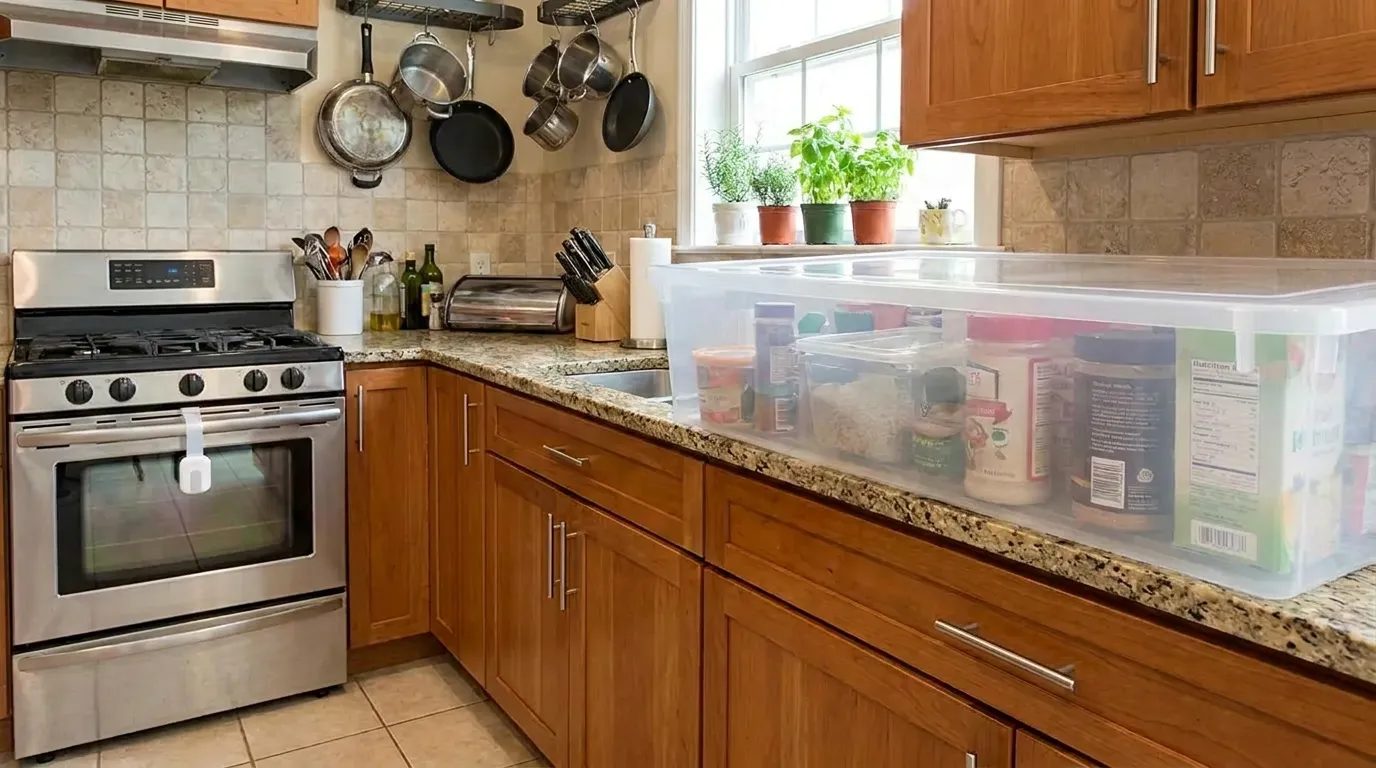
One hand child safety locks: What parents really need
When parents say they want one hand child safety locks, they usually mean more than "a latch that opens quickly." They are asking for a practical balance between adult convenience and toddler resistance.
A helpful child safety setup should support:
| Parent need | What it means in daily life |
|---|---|
| One-hand adult access | You may need to open a cabinet while holding a baby, groceries, or laundry. |
| Consistent use | If adults find a latch frustrating, they may leave it disengaged. |
| Cabinet and drawer fit | The latch should work with the cabinet frame, drawer spacing, and surface. |
| No-drill installation | Many parents want to avoid holes in cabinets, especially in rentals. |
| Toddler resistance | A latch should help reduce access to off-limit cabinets and drawers. |
| Regular inspection | Adhesive, alignment, and daily wear should be checked over time. |
This is why the "easiest" option is not always the same for every family. A frequently used kitchen cabinet may need a different setup than a rarely opened storage cabinet. A shallow drawer may need different planning than a standard under-sink cabinet.
For parents comparing baby proofing cabinet locks and cabinet latches, one useful starting point is to decide which cabinets and drawers contain the highest-risk items, then choose a latch style that adults can operate consistently.
One hand child safety locks and spring push latches: Are they easier?
Spring push latches are internal latches that typically let a cabinet or drawer open slightly. An adult then presses the internal release point so the cabinet or drawer can open fully. This design can feel convenient because there is no separate accessory to find, and the release may be reachable with one hand.
Spring push latches may feel easier when:
- The latch is installed where an adult finger can reach naturally.
- The cabinet or drawer opens just enough for a comfortable release.
- The latch is aligned correctly.
- The cabinet is used often, such as a kitchen storage cabinet.
- Adults understand the release motion after a quick demonstration.
However, spring push latches are not always easier. They may be frustrating when the release point is too deep, the drawer box blocks access, or the latch does not align smoothly. The slight opening can also invite tugging or rattling from a curious toddler. Older toddlers may observe adults and learn repeated motions, so no latch should be treated as completely childproof.
The key question is not only, "Can this be opened with one hand?" It is, "Can adults open it reliably while it still helps reduce toddler access?"
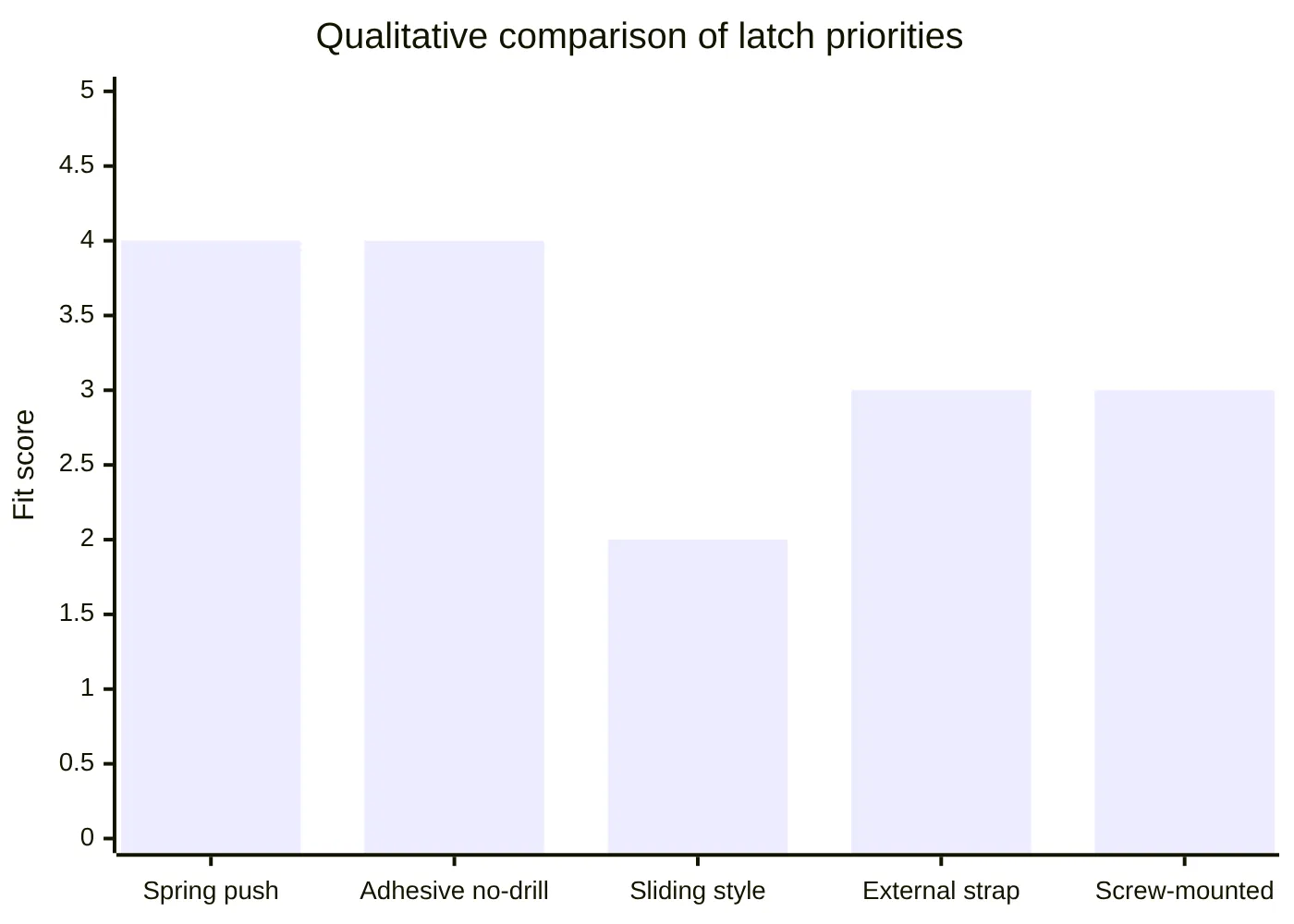
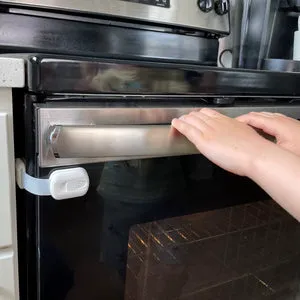
This chart is a practical comparison, not lab testing data. It shows why spring push latches and adhesive no-drill latches often stand out for parent convenience, while other options may fit more specific cabinet layouts.
One hand child safety locks for cabinets and drawers: Where safety comes first
Before choosing a latch style, think about what your child could reach. Babies and toddlers explore by pulling handles, opening drawers, and copying adults. Lower cabinets and drawers can quickly become access points for household items that should stay out of reach.
The American Academy of Pediatrics advises families to store medicines, cleaning products, laundry products, pesticides, and similar hazards in locked cabinets, out of sight and reach of children. You can review the guidance from HealthyChildren.org by the American Academy of Pediatrics. The U.S. Consumer Product Safety Commission also highlights poison prevention and safer storage at home. For U.S. households, Poison Control recommends saving 1-800-222-1222 for poison emergencies.
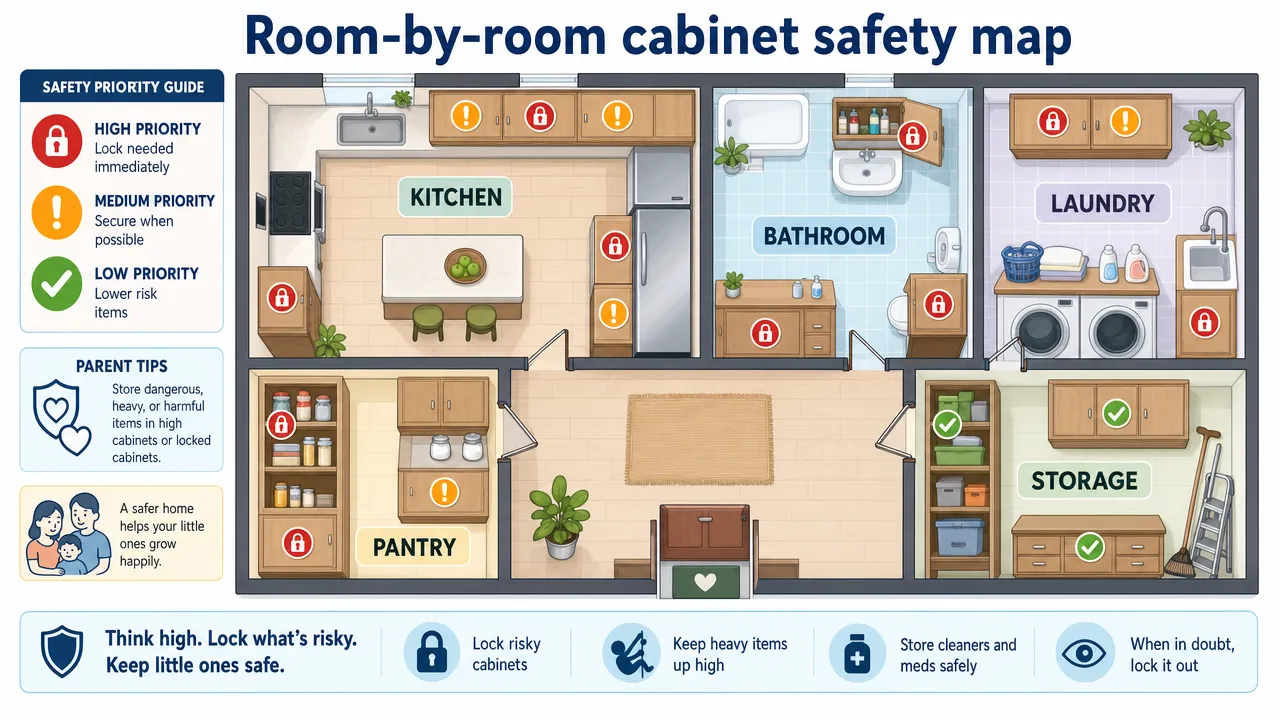
Common priority areas include:
| Room | Cabinets or drawers to check first | Common hazards |
|---|---|---|
| Kitchen | Under-sink cabinets, low drawers, pantry cabinets | Cleaning products, sharp tools, breakables, small objects |
| Bathroom | Vanity cabinets and low drawers | Medicines, razors, cosmetics, cleaning products |
| Laundry area | Low cabinets or storage shelves | Detergent packets, bleach, stain removers |
| Pantry | Lower shelves and cabinets | Breakables, plastic bags, small hard foods |
| Storage areas | Low cabinets and drawers | Tools, batteries, paints, small parts |
For child safety drawer latches, pay special attention to drawers that contain knives, scissors, batteries, small objects, or personal care items. A cabinet latch for toddlers should be part of a larger safety routine: supervision, safer storage, locked cabinets where needed, and regular checks.
One hand child safety locks vs adhesive no-drill cabinet latches
If one-handed access is your main concern, spring push latches are worth understanding. If no-drill installation is your main concern, adhesive cabinet latches may be a better fit. Many parents want both convenience and no cabinet damage, which is why adhesive, no-drill options are popular for family homes and rentals.
Adhesive no-drill latches are designed to attach without drilling. They can be useful on smooth, clean, dry surfaces, but installation quality matters. Grease, moisture, dust, textured finishes, and poor alignment can reduce performance. Always follow product instructions and inspect latches regularly.
For more planning support, VMAISI has related guides on best no-drill cabinet locks for child safety, adhesive vs screws for child safety locks, and adhesive cabinet lock comparisons. These can help parents think through installation surfaces, cabinet compatibility, and household coverage.
Use this quick comparison:
| Latch style | Parent convenience | Installation note | Watch-out |
|---|---|---|---|
| Spring push latches | Often good when reachable and aligned | Installation varies by product | Partial opening and toddler observation |
| Adhesive no-drill latches | Practical for many cabinets and drawers | Needs clean, dry, smooth surfaces | Adhesive bond and alignment matter |
| Sliding handle styles | Simple for certain paired handles | Usually no cabinet attachment | May not fit all drawers or knobs |
| External straps | Flexible for unusual surfaces | Adhesive dependent | Visible release may attract attention |
| Screw-mounted latches | Secure after proper installation | Requires holes and tools | More permanent |
A simple no-drill installation checklist:
- Empty or clear the cabinet area before installing.
- Clean the mounting surface and let it dry fully.
- Dry-fit the latch before removing adhesive backing.
- Check that the cabinet or drawer closes and catches properly.
- Press firmly during installation.
- Allow bonding time if the product instructions recommend it.
- Test adult access before storing hazards behind the latch.
- Recheck alignment and adhesion regularly.
One hand child safety locks: Choosing VMAISI 12 Pack or 20 Pack
For parents who prioritize no-drill installation, VMAISI adhesive child safety cabinet latches offer a practical way to help secure cabinets and drawers without drilling. They should be considered one safety layer, not a replacement for supervision or safer storage.
If you are starting with only a few high-priority areas, the VMAISI Cabinet Locks Child Safety Latches 12 Pack is a practical starter option. It may fit parents who want to begin with an under-sink cabinet, a bathroom vanity, several kitchen drawers, or a small apartment setup.
If you are planning broader coverage, the VMAISI Cabinet Locks Child Safety Latches 20 Pack is better suited for multiple cabinets and drawers across the kitchen, bathroom, pantry, laundry area, and storage spaces. The product page highlights upgraded stronger adhesive and no-drill installation, which can be helpful for larger baby-proofing projects.
| Your situation | Consider this option | Why it may fit |
|---|---|---|
| A few cabinets or drawers | VMAISI 12 Pack | Good for a focused first baby-proofing pass |
| Small apartment | VMAISI 12 Pack | Useful when you only need to secure key areas |
| Kitchen plus bathroom | VMAISI 20 Pack | Better for multiple high-priority rooms |
| Whole-home planning | VMAISI 20 Pack | More latches for cabinets and drawers across the home |
| Unsure how many you need | Count latch points first | Count each cabinet door and drawer, not just each room |
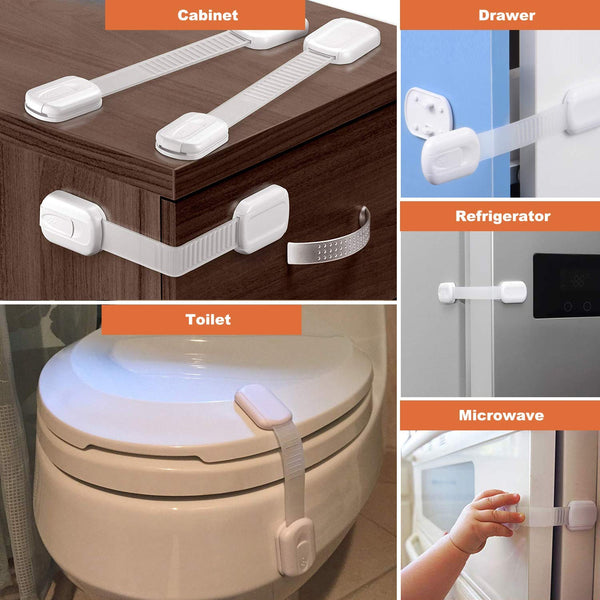
The best approach is to walk room by room and count every reachable cabinet door and drawer that needs a latch. Start with the highest-risk areas first, then expand as your baby becomes more mobile.
One hand child safety locks: Final answer and quick FAQs
So, are spring push latches easier for parents? Sometimes. They can be easier when they are reachable, aligned, and used on a cabinet or drawer that opens smoothly. They may not be easier if the release point is awkward, the cabinet design interferes, or the toddler learns the motion by watching adults.
For many families, the best choice is not simply "spring push latches or not." It is choosing a child-resistant setup that adults can use every day. If no-drill installation is a priority, VMAISI adhesive child safety cabinet latches are worth considering for cabinets and drawers, with the 12 Pack for starter projects and the 20 Pack for broader home coverage.
Can child safety drawer latches be opened with one hand?
Some latch styles may allow one-hand adult access, depending on cabinet fit, installation, and adult reach. Test the latch before relying on it for frequent-use cabinets.
Are spring push latches safe for toddlers?
They can help reduce toddler access when installed and used correctly, but no latch is completely childproof. Use them along with supervision and safer storage.
Are adhesive cabinet latches strong enough?
They can work well on compatible surfaces when installed correctly. Clean, dry, smooth surfaces and proper alignment are important.
Where should I install a cabinet latch for toddlers first?
Start with under-sink cabinets, drawers with sharp tools, bathroom cabinets, laundry storage, and low cabinets containing chemicals, medicines, batteries, or small objects.
How many cabinet latches do I need?
Count latch points, not rooms. Each cabinet door and drawer may need its own latch, depending on the design.
Can cabinet latches replace supervision?
No. They are a safety layer that helps reduce access, but they do not replace active supervision, safe storage, or regular home safety checks.