

Top 10 Best Adhesive Cabinet Locks in 2026
Adhesive cabinet locks matter most when a child begins crawling, pulling up, or quietly testing every cabinet door in the kitchen. Lower cabinets often hold cleaners, trash bags, dishwasher pods, tools, cosmetics, medicines, or sharp utensils, and a simple no-drill lock can add an important layer of child resistance without putting holes in your cabinets.
The hard part is that many adhesive cabinet locks look similar online. A low price, a big pack size, or a high rating does not tell you whether the lock fits your cabinet style, whether the adhesive will bond to your surface, whether adults can open it easily, or whether your toddler may learn the mechanism after a few weeks.
The best choice depends on lock type, surface compatibility, installation accuracy, adhesive curing time, and daily use. Hidden magnetic locks are popular for clean-looking kitchens, while non magnetic cabinet locks, spring cabinet locks, sliding locks, and strap locks may be better for families that do not want to manage a magnetic key.
This guide compares 10 adhesive cabinet locks and related child safety lock brands for 2026. It explains who each option is best for, what to check before buying, the realistic strengths and limitations, and how to choose stronger adhesive cabinet locks without relying on unsupported claims. Cabinet locks are child-resistant safety tools, not a substitute for supervision, safe storage, or following guidance from sources such as the CPSC childproofing guide and HealthyChildren home safety guidance.

10 best adhesive cabinet locks in 2026
- Vmaisi Adhesive Magnetic Cabinet Locks — best for hidden no-drill cabinet and drawer babyproofing
- Vmaisi Magnetic Drawer And Cabinet Locks 20 Pack — best for babyproofing multiple cabinets across a kitchen or bathroom
- Skyla Homes Magnetic Cabinet Locks — best for marketplace shoppers who want hidden magnetic locks
- Jool Baby Sliding Or Strap Locks — best for non magnetic cabinet locks on knobs, handles, fridges, and odd surfaces
- Safety 1st Adhesive Locks — best for parents who want a widely recognized babyproofing brand
- Dreambaby Adhesive Mag Locks — best for families comparing magnetic locks with indicator-style features
- Dreambaby Adhesive Safety Latches — best for simple non-magnetic adhesive latching
- Munchkin XtraGuard Multi-Use Latches — best for visible strap-style locking on cabinets and appliances
- Goodv Cabinet Locks — best treated as a limited-evidence marketplace option
- Yonktoo, Bates Choice, And Inaya Cabinet Locks — best treated as brands requiring verification before purchase
Best adhesive cabinet locks: detailed reviews
1. Vmaisi Adhesive Magnetic Cabinet Locks
Vmaisi Adhesive Magnetic Cabinet Locks are hidden adhesive magnetic locks designed for cabinets and drawers. They are a strong fit for parents who want child-resistant cabinet protection without visible straps or drill holes.
They work best on clean, smooth, dry interior cabinet surfaces. They are less ideal for metal cabinets, very thick cabinet fronts, rough paint, slippery Formica, or areas where hidden metal interferes with the magnetic key.

Key Features / Key Details:
- Hidden magnetic design — Keeps the lock inside the cabinet so toddlers cannot easily watch the mechanism.
- Adhesive installation — Supports no-drill babyproofing for renters and homeowners.
- Magnetic key access — Lets adults open the cabinet from the outside when the key is positioned correctly.
- Cabinet and drawer use — Works for many common cabinet and drawer layouts when aligned properly.
- Installation guidance — Vmaisi provides practical help in its guide on how to babyproof cabinets with magnetic locks.
Strengths:
- Good choice for parents who want a cleaner kitchen appearance.
- No drilling is helpful for rentals and newer cabinets.
- Internal guides explain surface prep, key placement, and troubleshooting.
- Useful for under-sink cabinets, bathroom vanities, and kitchen drawers.
- Magnetic access is harder for young toddlers to observe than visible latches.
Limitations:
- The magnetic key must be stored high and not misplaced.
- Adhesive strength depends on surface condition and cure time.
- Magnetic locks may not suit metal cabinets or unusually thick fronts.
Best for:
Vmaisi is best for families who want hidden adhesive cabinet locks for everyday kitchen, bathroom, and drawer babyproofing. It is especially practical for renters or homeowners who prefer a no-drill first approach.
Price / Pricing:
Price may vary by retailer, package size, or promotion.
2. Vmaisi Magnetic Drawer And Cabinet Locks 20 Pack
Vmaisi Magnetic Drawer And Cabinet Locks 20 Pack is better suited to whole-room or multi-room babyproofing than small starter packs. If you need to secure several lower kitchen cabinets, bathroom drawers, and storage areas, a larger pack reduces the chance of mixing different systems.
This option is not necessarily for someone who only needs one or two locks before a short visit. It makes more sense when you already know which cabinets are high risk and want one consistent lock style.

Key Features / Key Details:
- Larger pack size — Helps secure multiple cabinets and drawers with one system.
- Magnetic release — Keeps daily adult access relatively clean when the key is nearby.
- Hidden installation — Reduces visible plastic on cabinet fronts.
- Adhesive mounting — Avoids screw holes when surface conditions are suitable.
- Collection support — Buyers can compare related options on the Vmaisi magnetic cabinet locks collection.
Strengths:
- Efficient for full kitchen babyproofing.
- Consistent key-and-lock system across multiple cabinets.
- Hidden design works well in modern kitchens.
- Good fit for families preparing before a child starts walking.
Limitations:
- Requires more installation time than a small pack.
- Adhesive performance still depends on surface prep.
- May be more than needed for temporary caregiver visits.
Best for:
This is best for parents babyproofing an entire kitchen, rental unit, or grandparent home where several cabinets and drawers need the same hidden magnetic lock style.
Price / Pricing:
Price may vary by retailer, package size, or promotion.
3. Skyla Homes Magnetic Cabinet Locks
Skyla Homes appears in installation and review video contexts for adhesive magnetic cabinet locks. The brand is most relevant to parents who are comparing marketplace-style hidden magnetic lock packs and want a no-drill option.
Because the available research was limited mainly to video evidence rather than a verified current official product page, buyers should confirm pack size, adhesive type, cabinet thickness guidance, and return policy before purchasing.
Key Features / Key Details:
- Magnetic hidden design — Intended to keep the lock out of sight.
- Adhesive mounting — Designed around no-drill installation.
- Multi-pack positioning — Often discussed as a set for several cabinets.
- Key-based access — Requires adults to use a magnetic key.
- Marketplace availability — Details may vary by listing.
Strengths:
- Good concept for parents who want hidden locks.
- No-drill design can suit renters.
- Multi-pack formats may be convenient for kitchens.
- Magnetic access keeps toddlers from seeing a visible release button.
Limitations:
- Official current documentation was not strongly verified in the research.
- Claims should be checked against the active product listing.
- Like all magnetic locks, it depends on key storage and alignment.
Best for:
Skyla Homes may fit shoppers comfortable verifying marketplace listings and installation details before buying. It is not the best choice for buyers who want the strongest official documentation.
Price / Pricing:
Price may vary by retailer, package size, or listing.
4. Jool Baby Sliding Or Strap Locks
Jool Baby is more relevant for non magnetic cabinet locks than hidden adhesive magnetic systems. Its sliding locks suit paired knobs or handles, while strap-style products may help with appliances, fridges, and irregular surfaces.
This makes Jool Baby useful when magnetic keys are not desired. However, sliding locks and straps are usually visible and may not fit handleless cabinets.
Key Features / Key Details:
- Non-magnetic operation — No key to store or lose.
- Sliding lock format — Works on compatible paired knobs or handles.
- Strap lock options — Useful for appliances and odd surfaces depending on product.
- Visible status — Adults can see whether many external locks are engaged.
- Tool-free use cases — Some products are positioned for quick setup.
Strengths:
- Good for users who dislike magnetic keys.
- Helpful for cabinets with compatible handles.
- Strap styles can work beyond standard cabinets.
- Easier for caregivers to visually check.
Limitations:
- Not ideal for handleless modern cabinets.
- Visible design may not suit minimalist kitchens.
- Older toddlers may observe some visible mechanisms.
Best for:
Jool Baby is best for families needing non magnetic cabinet locks for knobs, handles, appliances, or temporary babyproofing where visible locks are acceptable.
Price / Pricing:
Price may vary by retailer and product type.
5. Safety 1st Adhesive Locks
Safety 1st is a widely recognized babyproofing brand with adhesive latch and adhesive magnetic lock options. It is a good benchmark brand for parents who want broad retail availability and official installation guidance.
The brand has manufacturer claims around adhesive strength and template-based setup, but any strength claim should be treated as the manufacturer statement unless supported by full independent testing.
Key Features / Key Details:
- Peel-and-stick positioning — Designed for no-tool installation.
- Adhesive latch and magnetic options — Gives buyers more than one lock style.
- Template-based setup — Helps improve alignment.
- Recognized babyproofing brand — Familiar to many US shoppers.
- Cure-time guidance — Installation videos emphasize waiting before heavy use.
Strengths:
- Easy to find through major retailers.
- Official videos and guides help reduce setup mistakes.
- Multiple product types support different cabinets.
- Good for parents who want a familiar brand name.
Limitations:
- Adhesive limitations still apply on dirty or textured surfaces.
- Some claims need to be read as brand-specific marketing claims.
- Magnetic versions still require key management.
Best for:
Safety 1st is best for parents who value brand recognition, official instructions, and mainstream retail access.
Price / Pricing:
Price may vary by retailer, package size, and product line.
6. Dreambaby Adhesive Mag Locks
Dreambaby Adhesive Mag Locks are hidden magnetic cabinet locks with official product documentation. They suit parents who want an established child-safety brand and like features such as indicator or disengage options on certain models.
They are less ideal for anyone who does not want to rely on a magnetic key or who has cabinet surfaces that do not support adhesive well.
Key Features / Key Details:
- Magnetic key release — Opens from outside the cabinet.
- Hidden installation — Keeps the front of the cabinet clean.
- Self-locking design — Helps the lock engage when the door closes.
- Indicator features on some models — Helps adults confirm lock status.
- Disengage option on some models — Useful when children are not present.
Strengths:
- Strong official product evidence.
- Hidden appearance works well for kitchens and bathrooms.
- Indicator features can help reduce user error.
- Magnetic design may be harder for toddlers to imitate.
Limitations:
- Requires keeping the key accessible to adults only.
- Adhesive success depends on surface condition.
- Availability and features may vary by model.
Best for:
Dreambaby Adhesive Mag Locks are best for parents comparing hidden magnetic locks from established safety brands and wanting lock-status features.
Price / Pricing:
Price may vary by retailer and package size.
7. Dreambaby Adhesive Safety Latches
Dreambaby Adhesive Safety Latches are a non-magnetic alternative for parents who prefer a simpler latch mechanism. Unlike magnetic locks, these typically allow the cabinet to open slightly so an adult can press or release the latch.
They are practical for families that do not want keys, but they may be more visible during use because the cabinet opens enough for release.
Key Features / Key Details:
- Non-magnetic latch — Avoids key storage issues.
- Adhesive mounting — Supports no-drill installation.
- Inside-cabinet placement — Less visible than external straps.
- Adult press-release use — Simple for frequent-access cabinets.
- Multi-pack availability — Useful for several cabinets.
Strengths:
- No magnetic key to lose.
- Straightforward for caregivers to understand.
- Good for daily-use cabinets.
- Helpful for families comparing spring cabinet locks and adhesive latches.
Limitations:
- Cabinet opens slightly before release.
- Older toddlers may learn some latch behavior.
- Requires enough internal space and proper alignment.
Best for:
This is best for families who want non magnetic cabinet locks with a simple adhesive latch style rather than a hidden magnetic system.
Price / Pricing:
Price may vary by retailer and pack size.
8. Munchkin XtraGuard Multi-Use Latches
Munchkin XtraGuard-style latches are visible adhesive strap locks used across cabinets, drawers, toilet seats, appliances, and other household surfaces. They are not the cleanest-looking option, but they can solve problems that internal cabinet locks cannot.
This makes them useful for fridges, corner surfaces, and places where a hidden latch does not fit. They are less appealing for homeowners who want invisible babyproofing.
Key Features / Key Details:
- Flexible strap design — Spans gaps and corners.
- Dual-action release — Adds an extra step for children.
- Adhesive pads — Attach externally to surfaces.
- Multi-use format — Works beyond cabinets depending on surface and product.
- Visible lock status — Adults can quickly see if it is engaged.
Strengths:
- Good for appliances and unusual surfaces.
- No magnetic key required.
- Easy to inspect visually.
- Useful as a supplement to internal locks.
Limitations:
- Visible on cabinet and appliance fronts.
- Adhesive pads may leave residue if removed poorly.
- Not ideal for a fully hidden look.
Best for:
Munchkin is best for families who need a flexible, non-magnetic, visible strap lock for appliances, toilet seats, corner situations, or cabinets that do not accept internal locks.
Price / Pricing:
Price may vary by retailer and package size.
9. Goodv Cabinet Locks
Goodv was included in the requested comparison, but the research found limited reliable evidence from official or major-retailer sources. That does not mean the product is unsuitable; it means buyers should verify details carefully before treating it as a top recommendation.
For safety products, unclear documentation is a real limitation. Parents should confirm lock type, adhesive instructions, pack contents, return policy, and compatibility before buying.
Key Features / Key Details:
- Product type — Not confidently verified from official sources.
- Adhesive claims — Should be checked on the active listing.
- Installation method — Verify whether it is adhesive, screw-mounted, or both.
- Safety instructions — Review before purchase.
- Evidence level — Limited based on the provided research.
Strengths:
- May be available through marketplace channels.
- Could fit budget-focused shoppers if verified.
- May offer common cabinet-lock formats.
- Worth considering only after checking current documentation.
Limitations:
- No strong official product evidence in the research.
- Specific features should not be assumed.
- Not ideal for buyers who want well-documented safety products.
Best for:
Goodv is best treated as a brand to verify, not a first-choice recommendation, especially for high-risk cabinets containing cleaners or medicines.
Price / Pricing:
Price may vary by retailer or listing.
10. Yonktoo, Bates Choice, And Inaya Cabinet Locks
Yonktoo, Bates Choice, and Inaya were requested for review, but the research did not verify reliable official or major-retailer product pages for current adhesive cabinet locks. For that reason, they should be treated as limited-evidence options rather than ranked safety picks.
If you see these brands in a marketplace, evaluate them using the same standards as better-documented locks: installation instructions, surface compatibility, return policy, safety warnings, customer support, and clear pack contents.
Key Features / Key Details:
- Lock type — Not reliably verified from the research.
- Adhesive details — Must be confirmed before purchase.
- Compatibility — Do not assume fit with drawers, corner cabinets, or thick doors.
- Documentation — Look for clear installation and removal instructions.
- Evidence level — Low based on available sources.
Strengths:
- May appear as budget or marketplace alternatives.
- Could be useful if current listings provide clear details.
- Worth checking if you need a specific form factor.
- May fill temporary-use needs after verification.
Limitations:
- Limited verified product evidence.
- Unknown current availability and feature set.
- Not recommended for buyers who want strong documentation.
Best for:
These brands are best for careful marketplace shoppers who are willing to verify the exact product before purchase. For high-risk storage areas, better-documented options are usually easier to evaluate.
Price / Pricing:
Price may vary by listing and availability.
Adhesive cabinet locks compared
| Product | Best For | Type | Installation / Setup | Compatibility | Strengths | Limitations | Price |
|---|---|---|---|---|---|---|---|
| Vmaisi Adhesive Magnetic Cabinet Locks | Hidden no-drill babyproofing | Adhesive magnetic | Clean, align, press, cure | Many cabinets and drawers | Hidden look, internal guidance | Key required; surface dependent | Varies |
| Vmaisi 20 Pack Magnetic Locks | Multi-cabinet setup | Adhesive magnetic | Best for planned whole-room installation | Kitchens, bathrooms, drawers | Consistent system across many cabinets | More than needed for small jobs | Varies |
| Skyla Homes | Marketplace magnetic option | Adhesive magnetic | Verify current instructions | Depends on listing | Hidden concept | Limited official evidence | Varies |
| Jool Baby | Non-magnetic knobs, handles, appliances | Sliding or strap | Tool-free or adhesive depending on model | Handles, knobs, appliances | No magnetic key | Often visible | Varies |
| Safety 1st | Recognized mainstream brand | Adhesive latch or magnetic | Template and cure-time guidance | Broad retail product range | Strong documentation | Adhesive limits still apply | Varies |
| Dreambaby Mag Locks | Hidden magnetic with indicators | Adhesive magnetic | Internal installation | Cabinets and drawers | Official documentation, hidden design | Key required | Varies |
| Dreambaby Safety Latches | Simple non-magnetic latch | Adhesive latch | Inside-cabinet setup | Standard cabinets | No key needed | Door opens slightly | Varies |
| Munchkin XtraGuard | Appliances and odd surfaces | Adhesive strap | External adhesive pads | Fridges, cabinets, toilet seats | Multi-use | Visible | Varies |
| Goodv | Verification-only option | Unverified | Check listing | Unknown | Possible budget option | Limited evidence | Varies |
| Yonktoo, Bates Choice, Inaya | Verification-only marketplace options | Unverified | Check listing | Unknown | May be available online | Low evidence | Varies |
How to choose and use adhesive cabinet locks
Choosing the right adhesive cabinet locks depends less on which option looks best on paper and more on your use case, budget, environment, workflow, safety requirements, and long-term needs.
1. Adhesive cabinet locks use case fit
Start with the cabinet contents. Under-sink cleaners, medicines, sharp tools, dishwasher pods, and cosmetics deserve higher priority than empty or low-risk storage areas. The CPSC notes that safety latches and locks can help reduce access to household hazards, but they are only one safety layer.
If you want a clean look, hidden magnetic locks such as Vmaisi magnetic cabinet locks are a natural fit. If you want no key, consider non magnetic cabinet locks, adhesive latches, visible straps, or spring cabinet locks.
2. Adhesive cabinet locks compatibility
Check cabinet type before buying. Overlay doors, inset drawers, corner cabinets, thick drawer fronts, metal surfaces, and narrow frames can affect installation.
For unusual layouts, Vmaisi has a helpful guide on magnetic cabinet locks for corner cabinets. If your cabinet has hidden metal, very thick fronts, or awkward angles, test the magnetic release position before final adhesive placement.
3. Adhesive cabinet locks setup and surface prep
Adhesive locks need a clean, dry, smooth surface. Grease, dust, wax, rough paint, peeling veneer, and slippery surfaces can weaken the bond.
Dry-fit the lock before removing the backing. Use a template or cradle if included, press firmly after placement, and follow the manufacturer cure-time instructions; many adhesive locks recommend several hours to 24 hours before heavy use.
4. Adhesive cabinet locks safety and reliability
Use the term "child-resistant," not "childproof." A determined toddler, poor installation, or worn adhesive can reduce reliability.
Store hazardous items high and locked when possible, keep medicines in child-resistant containers, and call Poison Control immediately if exposure or ingestion is suspected. Locks reduce risk; they do not guarantee prevention.
5. Adhesive cabinet locks daily usability
A lock that frustrates adults may get disabled or left open. Magnetic locks are tidy but require a key nearby and out of reach. Non-magnetic latches avoid keys but may be easier for older toddlers to study.
For frequently used cabinets, test whether adults can open the lock one-handed, whether guests can understand it, and whether the mechanism catches reliably after repeated closing.
6. Adhesive cabinet locks durability and maintenance
Inspect locks regularly. Check for peeling corners, weak adhesive, misalignment, cracked plastic, lost keys, or doors that no longer catch.
If a lock loosens, do not rely on it for high-risk storage. Reinstall according to instructions, switch to another surface, or consider a screw-reinforced option where drilling is acceptable.
7. Adhesive cabinet locks price and long-term value
Do not buy only by the lowest price. A cheap multi-pack that does not fit your cabinet style can cost more in replacement time and frustration.
Look at pack size, replacement keys, installation tools, documentation, surface compatibility, and whether you need hidden, visible, magnetic, non-magnetic, or spring cabinet locks. Long-term value comes from a lock you will install correctly and use consistently.
Key features to look for in adhesive cabinet locks
Adhesive strength
Look for clear adhesive instructions, suitable surface guidance, and cure-time recommendations. Stronger adhesive cabinet locks depend on tape quality, surface prep, contact area, and correct installation.
Hidden or visible design
Hidden locks are better for clean cabinet fronts. Visible strap locks are easier to inspect and often better for appliances or odd surfaces.
Magnetic or non-magnetic access
Magnetic locks are discreet but require key storage. Non magnetic cabinet locks avoid keys but may be more visible or learnable.
Cabinet and drawer compatibility
A lock should match your cabinet depth, door style, drawer front, and available mounting area. Do not assume one lock fits every layout.
Installation template or cradle
Templates reduce alignment mistakes. This matters because a poorly aligned latch may fail to catch or may be hard for adults to release.
Adult ease of use
If adults struggle, they may bypass the lock. Choose a release mechanism that fits your daily routine.
Damage-aware removal
Adhesive avoids screw holes, but removal can still affect paint or veneer. Vmaisi discusses careful removal and troubleshooting in its guide on magnetic locks on corner cabinets.
Replacement and support options
Magnetic systems are easier to live with when spare keys or replacement parts are available.
What adhesive cabinet locks are and how adhesive cabinet locks work
A cabinet lock is a child safety product that helps parents and caregivers reduce toddler access to cabinets, drawers, and cupboards. Adhesive cabinet locks attach with adhesive tape instead of screws, and they typically help users secure lower storage areas, reduce access to hazardous items, and babyproof cabinets without drilling.
Unlike a loose rubber band, improvised tie, or simply telling a toddler "no," a dedicated adhesive cabinet lock is designed to make cabinet access more repeatable and child-resistant. It can help:
- Reduce access to cleaners, medicines, sharp items, and choking hazards.
- Support renter-friendly no-drill babyproofing.
- Make under-sink and bathroom storage safer when used correctly.
- Protect pet food, trash, or pantry areas from pets.
- Add a safety layer while adults continue supervision.
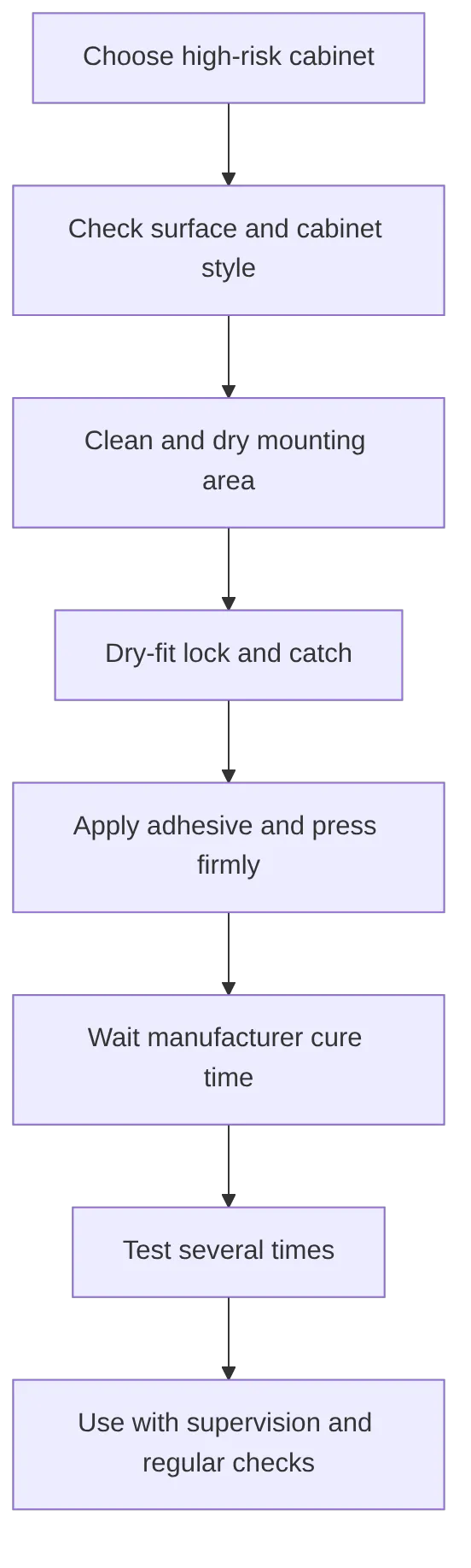
Here is the practical installation flow:
-
Identify the risk or use case
Start with the highest-risk cabinets first. Prioritize cleaners, medicines, knives, tools, laundry products, and small choking hazards. -
Check compatibility
Look at cabinet style, door thickness, drawer spacing, surface texture, and whether hidden metal may affect magnetic locks. For corner cabinets or unusual layouts, test before final installation. -
Clean and prepare the surface
Wipe away dust, oil, grease, and furniture polish. Let the surface dry fully because moisture and residue can weaken adhesion. -
Install or attach the product according to instructions
Dry-fit first, use any provided template, then press the adhesive firmly in place. Avoid repositioning repeatedly because it can reduce the bond. -
Test it before relying on it
Open and close the cabinet several times. For magnetic locks, confirm the key releases the latch from the outside before putting hazardous items behind it. -
Use it consistently in daily routines
Close cabinets fully after every use. Store magnetic keys high and out of reach, not hanging from the cabinet handle. -
Inspect regularly and replace if worn or loose
Check adhesive edges, latch alignment, and plastic parts. Replace or reinstall any lock that no longer catches reliably.
Common mistakes include buying only by price, ignoring cabinet compatibility, installing on a dirty surface, skipping cure time, assuming one product fits every cabinet, and treating safety products as a substitute for supervision.
Adhesive cabinet locks FAQ and final recommendation
Adhesive cabinet locks are worth considering because they add a practical safety layer without drilling into cabinets. The best option depends on whether you want hidden magnetic locks, visible non-magnetic locks, spring cabinet locks, strap locks, or a larger multi-pack for several rooms.
No single product is right for every home. If you want a hidden, no-drill system, start with Vmaisi Adhesive Magnetic Cabinet Locks or compare the broader Vmaisi magnetic cabinet locks collection. If you do not want magnetic keys, compare non magnetic cabinet locks, adhesive latches, and strap locks from brands such as Jool Baby, Dreambaby, or Munchkin.
If you need stronger adhesive cabinet locks, focus on surface prep, fit, cure time, and correct alignment rather than unsupported "strongest" claims. If your cabinet contains high-risk items, combine locks with safer storage, supervision, and regular inspections.
What is the best adhesive cabinet lock?
The best adhesive cabinet lock depends on your cabinet style and how you want adults to open it. Hidden magnetic locks such as Vmaisi are a strong fit for families who want no visible straps and no drilling. Non magnetic cabinet locks are better if you do not want to manage a magnetic key. Strap locks work well on appliances and odd surfaces. For high-risk cabinets, choose a well-documented product, follow installation instructions carefully, and check the lock regularly.
What do adhesive cabinet locks do?
Adhesive cabinet locks help slow or reduce a child's access to cabinets, drawers, cupboards, and some appliances. They are commonly used on under-sink cabinets, bathroom vanities, kitchen drawers, and lower storage areas that may contain cleaners, medicines, tools, or sharp items. They attach with adhesive tape rather than screws, making them useful for renters and no-drill setups. They are child-resistant, not guaranteed childproof, so adult supervision and safe storage remain necessary.
Are magnetic or non magnetic cabinet locks better?
Magnetic and non magnetic cabinet locks solve different problems. Magnetic locks are usually hidden inside the cabinet, which keeps the outside clean and makes the mechanism harder for toddlers to observe. The trade-off is that adults need a magnetic key and must store it safely. Non-magnetic latches, straps, sliding locks, and spring cabinet locks avoid key management, but they may be visible or easier for older toddlers to study. Choose based on your cabinet layout and daily habits.
Are adhesive cabinet locks strong enough?
Adhesive cabinet locks can be strong enough for many household cabinets when installed on clean, smooth, dry surfaces and allowed to cure according to manufacturer instructions. Adhesive strength depends on surface material, contact area, alignment, heat, moisture, and repeated pulling. Rough paint, grease, wax, dust, and textured surfaces can reduce performance. For heavy-use or high-risk cabinets, consider adhesive-plus-screw options if drilling is allowed, or move hazardous items to higher locked storage.
Can renters use adhesive cabinet locks?
Yes, adhesive cabinet locks are popular with renters because they avoid screw holes. However, adhesive does not mean risk-free removal on every finish. Painted, veneered, old, peeling, or delicate surfaces can still be damaged if the lock is pulled off too quickly. Test discreetly when possible, follow the product instructions, and remove slowly using gentle heat and a plastic card if appropriate. If your lease is strict, choose the least invasive lock that still fits the risk level.
How often should adhesive cabinet locks be checked or replaced?
Check adhesive cabinet locks regularly, especially on high-use cabinets and under-sink areas. Look for peeling adhesive, loose lock bodies, misaligned catches, cracked plastic, missing magnetic keys, or doors that no longer latch properly. Inspect after cleaning, after humid weather, and whenever a child pulls hard on a cabinet. Replace or reinstall any lock that feels loose. A cabinet lock should never be relied on if the adhesive bond or latch action is uncertain.