

Best No Drill Cabinet Locks for Child Safety
Are you staring at your kitchen cabinets wondering if no drill cabinet locks are really strong enough to help keep your baby away from cleaners, sharp tools, medicines, and hidden household hazards? That worry is common, especially when a baby suddenly starts crawling, pulling up, and opening anything within reach.
The good news: no drill cabinet locks can be a practical child-resistant layer for many homes, especially for renters or parents who do not want holes in finished cabinets. The important part is choosing the right style, installing it carefully, and remembering that cabinet locks work best alongside safe storage and active supervision.

Why no drill cabinet locks matter before your baby starts exploring
Low cabinets are often filled with things adults use every day but babies should not access: cleaning products, dish detergents, trash bags, medicines, razors, knives, peelers, small objects, and breakable containers. Once your baby becomes mobile, a cabinet that seemed harmless yesterday can become a daily safety concern.
The U.S. Consumer Product Safety Commission recommends using safety latches and locks on cabinets and drawers to help prevent access to dangerous items. Safe Kids Worldwide also advises locking up medicines and household cleaners and keeping them out of children's reach. For poison prevention information and emergency resources, parents can also refer to Poison Control and pediatric guidance from HealthyChildren.org.
Still, no drill cabinet locks should not be treated as a complete safety solution by themselves. They are child-resistant, not childproof in an absolute sense. The safer approach is to combine them with these habits:
- Store medicines, cleaners, and chemicals high and locked whenever possible.
- Prioritize under-sink cabinets, bathroom cabinets, laundry areas, and knife drawers.
- Test every lock after installation.
- Inspect adhesive cabinet locks regularly for shifting, peeling, or misalignment.
- Keep magnetic keys high and out of reach if using magnetic locks.
- Supervise babies and toddlers, especially in kitchens and bathrooms.
Types of no drill cabinet locks for different cabinets
No drill cabinet locks are popular because they are easier to install than screw-mounted latches and can help avoid permanent cabinet holes. But there are several styles, and the best choice depends on your cabinet layout, surface type, and the items stored inside.
| Lock type | How it works | Best for | Watch-outs |
|---|---|---|---|
| Adhesive cabinet locks | Attach with peel-and-stick adhesive, usually inside or outside the cabinet | Renters, finished cabinets, quick installation | Adhesive strength depends on surface prep, alignment, and wait time |
| Magnetic cabinet locks | Hidden inside the cabinet and released with a magnetic key | Parents who want an invisible look and harder-to-understand operation for toddlers | Magnetic key must be stored safely; thick doors or metal parts may interfere |
| Strap-style adhesive locks | External adhesive strap bridges two surfaces | Appliances, toilets, fridges, some odd cabinet shapes | Visible from outside; adhesive pads still need inspection |
| Screw-mounted locks | Fastened mechanically with screws | High-use or high-risk cabinets where drilling is acceptable | Requires tools and leaves holes |
For many families, hidden magnetic adhesive locks are a strong balance of convenience and appearance. Vmaisi offers a magnetic cabinet locks collection designed for parents who want cabinet and drawer protection without visible bulky hardware.
If you are specifically comparing cabinet locks without screws, Vmaisi also has a helpful guide on magnetic cabinet locks without screws, which explains why no drilling cabinet locks appeal to parents who want a cleaner installation.
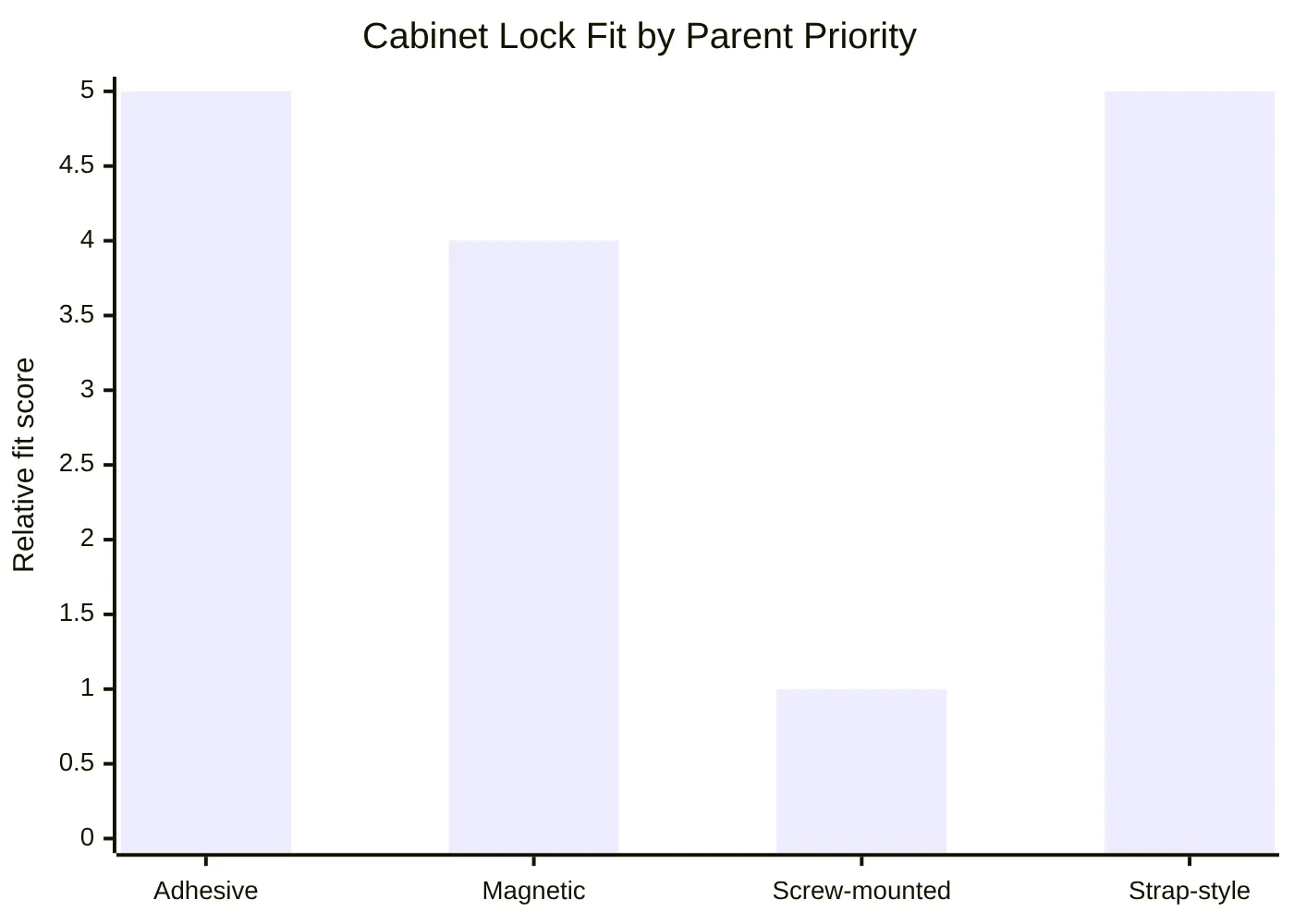
This chart shows one simple way to think about convenience: adhesive and strap-style locks are typically the easiest no-drill options, while magnetic locks add a hidden appearance. Screw-mounted locks can be more permanent, but they are not ideal if you want to avoid holes.
Are adhesive no drill cabinet locks strong enough?
Parents searching for stronger adhesive cabinet locks usually have one real question: 'Will this stay on when my toddler pulls?' The answer depends less on a single label and more on installation quality, surface compatibility, and ongoing inspection.
Adhesive cabinet locks can work well when installed correctly on a compatible surface. But adhesive may not perform well on dirty, oily, waxed, rough, peeling, or highly textured surfaces. Vmaisi notes on its Vmaisi adhesive magnetic cabinet locks product page that adhesive effectiveness depends on the cabinet surface, and that attachment areas should be clean and free of oils or furniture wax.

For stronger adhesive cabinet locks in real-world use, focus on these factors:
- Clean the surface first. Remove dust, grease, furniture polish, and residue.
- Let the area dry completely. Adhesive should not be applied to a damp surface.
- Dry fit before sticking. Test where the lock and catch will sit before removing the backing.
- Align carefully. A poorly aligned latch may not engage properly.
- Press firmly. Full contact helps the adhesive pad bond evenly.
- Wait before heavy use. If the product instructions recommend a set time, follow them before relying on the lock.
- Inspect often. Repeated pulling, humidity, heat, or cabinet movement can affect adhesive over time.

If you are installing hidden magnetic locks, alignment matters even more. Vmaisi's installation content recommends testing placement and checking for possible interference before final placement. You can read more in the Vmaisi guide on how to install magnetic cabinet locks.
For unusual cabinet shapes, corner cabinets, or layouts with hidden metal parts, Vmaisi also offers practical advice on whether magnetic locks fit corner cabinets. This is useful because hidden metal screws, staples, or cabinet components can sometimes affect magnetic operation.
How to install no drill cabinet locks correctly
Installation is where many no drilling cabinet locks either succeed or disappoint. A good product can fail if it is stuck to a waxy cabinet, placed too far from the catch, or used immediately before the adhesive has bonded.

Use this parent-friendly workflow:
| Step | What to do | Why it matters |
|---|---|---|
| 1. Choose priority cabinets | Start with under-sink, bathroom, laundry, and sharp-tool drawers | These areas often contain the highest-risk items |
| 2. Check the surface | Look for rough paint, wax, oil, moisture, or texture | Adhesive cabinet locks need compatible surfaces |
| 3. Clean and dry | Wipe the area and let it dry fully | A clean bond is usually stronger |
| 4. Dry fit | Position the lock and catch before removing adhesive backing | Prevents misalignment |
| 5. Test movement | Make sure the latch catches and the magnetic key reaches | Confirms function before final placement |
| 6. Press firmly | Apply even pressure to the adhesive area | Helps the pad make full contact |
| 7. Wait if instructed | Follow the product's recommended bonding time | Reduces early adhesive failure |
| 8. Inspect regularly | Look for peeling, shifting, or weak engagement | Maintains the child-resistant layer |
For magnetic models, store the magnetic key high and out of reach. A magnetic lock is convenient for adults, but the key should never become a toy or be left on a low counter. If you lose keys often, consider keeping one in a high, consistent location that adults can reach but children cannot.
Also remember that adhesive locks are not always the best choice for every cabinet. If a cabinet holds especially hazardous items and the adhesive repeatedly fails, move the hazard to a safer location and consider another locking method. No lock should be your only line of defense for medicines, chemicals, or sharp tools.
Best Vmaisi no drill cabinet locks to consider
If you want a hidden design and no-hole installation, the Vmaisi Adhesive Magnetic Cabinet Locks for Babies, 8 Locks and 2 Keys are a strong starting point. They are relevant for parents looking for adhesive cabinet locks that install inside cabinets and open with a magnetic key. The product information also emphasizes important installation realities, including surface preparation and potential metal interference.
For larger babyproofing projects, the Vmaisi Child Safety Magnetic Drawer and Cabinet Locks, 20 Pack may be a better fit. This option is useful if you are securing multiple kitchen cabinets, bathroom drawers, and storage areas at once.
If you are still comparing pack sizes or lock styles, start with the Vmaisi magnetic cabinet locks collection. It gives you a broader view of no drill cabinet locks for cabinets and drawers.

When choosing between the 8-pack and 20-pack options, think room by room. A small apartment may only need protection on the most important cabinets, while a larger home may need locks for the kitchen, bathroom, laundry area, and low drawers. For corner cabinets or unusual layouts, review Vmaisi's guide to magnetic cabinet locks for corner cabinets before installation.
No drill cabinet locks FAQs and final safety checklist
Are no drill cabinet locks safe for babies and toddlers?
They can help reduce access to cabinet contents when chosen, installed, tested, and inspected correctly. They should be used as one layer of a broader safety plan, not as a replacement for supervision or safer storage.
Are adhesive cabinet locks strong enough?
They can be effective on clean, smooth, dry, compatible surfaces. The most common problems come from poor surface prep, misalignment, rough or waxed finishes, early use before bonding, and lack of inspection.
Do no drilling cabinet locks damage cabinets?
They avoid screw holes, which is why many renters prefer them. However, adhesive removal can still affect some painted or delicate finishes. Always follow removal instructions and test carefully if you are concerned about the finish.
Are magnetic cabinet locks better than visible adhesive locks?
Magnetic locks are popular because they are hidden from the outside and harder for toddlers to understand. However, they require a magnetic key, careful placement, and testing for door thickness or hidden metal interference.
Where should parents install cabinet locks first?
Start with the highest-risk areas: under-sink cabinets, bathroom cabinets, laundry storage, drawers with knives or tools, and any low cabinet containing medicines, cleaners, small objects, or breakable items.
What if my adhesive lock keeps coming off?
Stop relying on that lock for hazardous items. Recheck the surface, clean and dry it, reinstall only if compatible, and consider a different lock style or safer storage location. For high-risk cabinets, moving hazards up and out of reach is often the safest first step.
Final checklist before you call the project done:
- High-risk items moved high or locked away.
- No drill cabinet locks installed on priority cabinets.
- Adhesive surfaces cleaned and dried before installation.
- Locks aligned, pressed firmly, and tested.
- Magnetic keys stored high and out of reach.
- Cabinets inspected regularly.
- Poison prevention resources bookmarked or saved.
No drill cabinet locks can make daily life feel more manageable for parents of curious babies and toddlers. Choose the right style, install it with patience, and keep your safety plan layered. If you are ready to babyproof cabinets without drilling, explore the Vmaisi magnetic cabinet locks collection or start with Vmaisi adhesive magnetic cabinet locks.