

Adhesive vs Screws: Best Child Safety Locks
Are you confused about whether adhesive or screw-mounted cabinet locks are safer for your baby, especially when you need home safety locks that hold securely, install without stress, and do not ruin your cabinets when you move?
You are not alone. Once a baby starts crawling, pulling up, and opening doors, everyday cabinets and drawers suddenly become risk zones. Cleaning products, medicine, dishwasher pods, knives, batteries, cosmetics, and appliance doors can all become reachable faster than parents expect. The right answer is not simply "adhesive" or "screws." The best choice depends on the cabinet surface, the hazard level, whether you rent or own, and how permanent you want the installation to be.

Quick answer for home safety locks: adhesive vs screws
For most families, the safest and most practical setup is a mix of home safety locks, not one lock type everywhere.
Adhesive locks are usually best for renters, smooth cabinet surfaces, quick babyproofing, and lower-to-medium risk areas. They are no-drill, easier to install, and often easier to remove than screw-mounted locks. However, adhesive strength depends on surface preparation, cure time, humidity, heat, and repeated pulling.
Screw-mounted locks are usually better for long-term use and high-risk cabinets, such as cabinets holding medicines, chemicals, sharp tools, batteries, or cleaning products. Screws provide a stronger mechanical attachment, but they leave holes and require more careful installation.
Magnetic cabinet locks are a lock type, not just a mounting method. Some are adhesive-mounted, some are screw-mounted, and some allow adhesive plus optional screws. Vmaisi options are designed to install inside cabinets and drawers, staying hidden from the outside. For example, parents can review the Vmaisi Child Safety Magnetic Drawer & Cabinet Locks 20 Pack for cabinets and drawers where an invisible internal lock is compatible.

| Situation | Better choice | Why |
|---|---|---|
| Rental home or apartment | Adhesive locks | No drilling and easier removal |
| High-risk medicine or chemical cabinet | Screw-mounted or adhesive-plus-screw locks | Stronger long-term attachment |
| Modern kitchen with clean design | Magnetic cabinet locks | Hidden from outside |
| Drawers with knives or tools | Magnetic drawer locks | Internal latch helps limit access |
| Fridge, dishwasher, oven, or toilet | Strap or appliance-specific locks | Better fit for thick, metal, hot, or irregular surfaces |
Some parents search terms like safety usa or safetyfirst when comparing babyproofing options, but the real decision should focus on fit, installation quality, and hazard level rather than brand familiarity alone.
Why home safety locks matter beyond cabinets
Home safety locks are useful, but they are only one layer of protection. The American Academy of Pediatrics recommends childproofing the home by securing hazards, using safety devices, and maintaining active supervision. The AAP childproofing guidance is clear that parents should reduce access to hazards before children can reach them.
Medication storage deserves special attention. The CDC medication safety guidance recommends keeping medicines, vitamins, and supplements up, away, and out of sight. Safe Kids Worldwide also reminds parents that child-resistant packaging does not mean child-proof. Their medicine safety tips support locked storage and immediate put-away habits after every use.
The same layered approach applies to other rooms. The CPSC child safety center frames home safety as a system, not a single product. So baby proofing cabinet locks, child safety cabinet locks, child safety locks for drawers, and appliance locks should work together with safer storage, supervision, and regular checks.
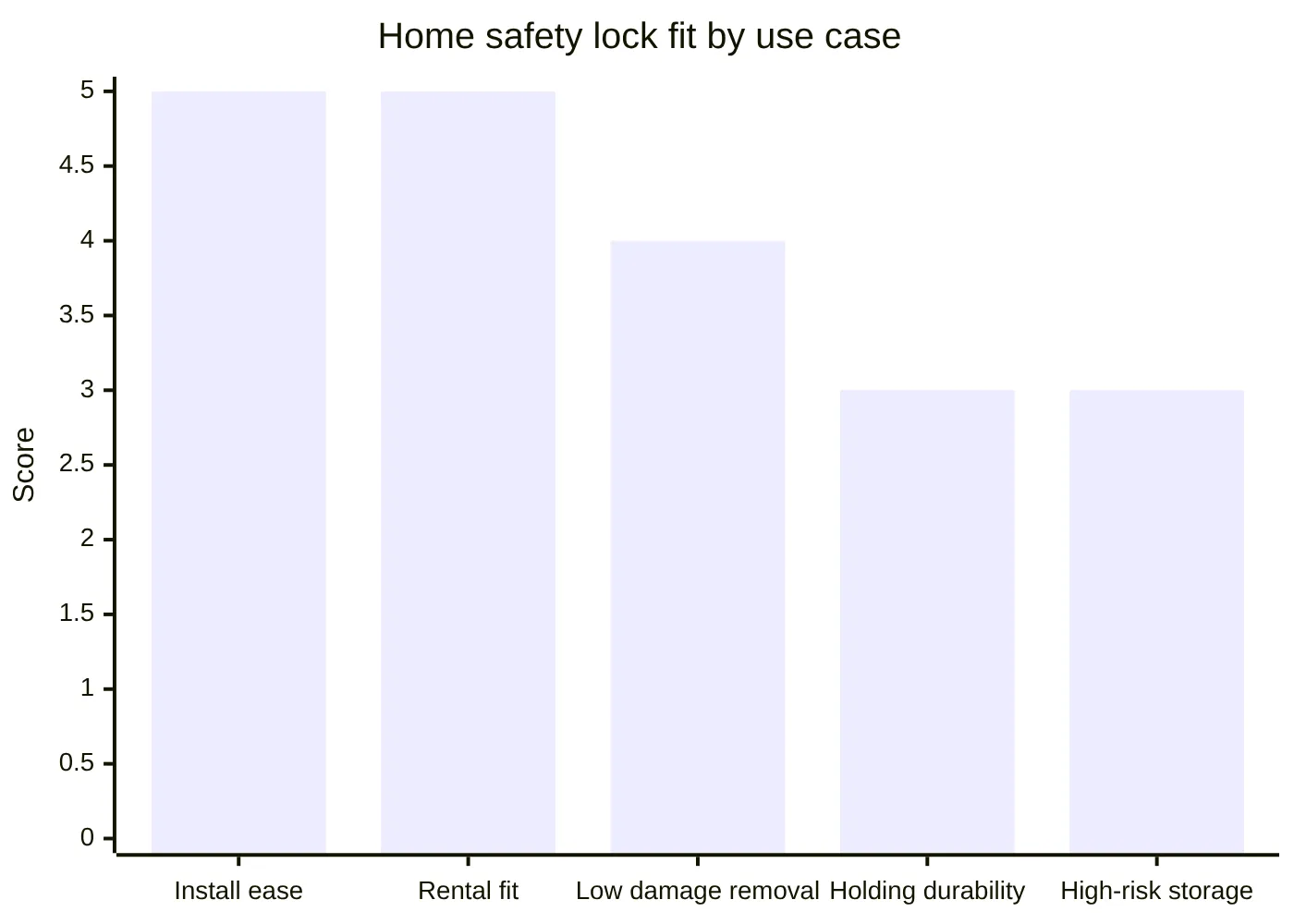
This chart represents adhesive lock fit. Adhesive home safety locks are convenient and renter-friendly, but they should be inspected regularly and used thoughtfully around high-risk items.
Choosing home safety locks for cabinets, drawers, and magnetic systems
Babyproof cabinet locks come in several styles, and each style solves a different problem. The main categories are adhesive cabinet locks, screw-mounted locks, magnetic cabinet locks, magnetic drawer locks, invisible cabinet locks, strap locks, and appliance-specific locks.

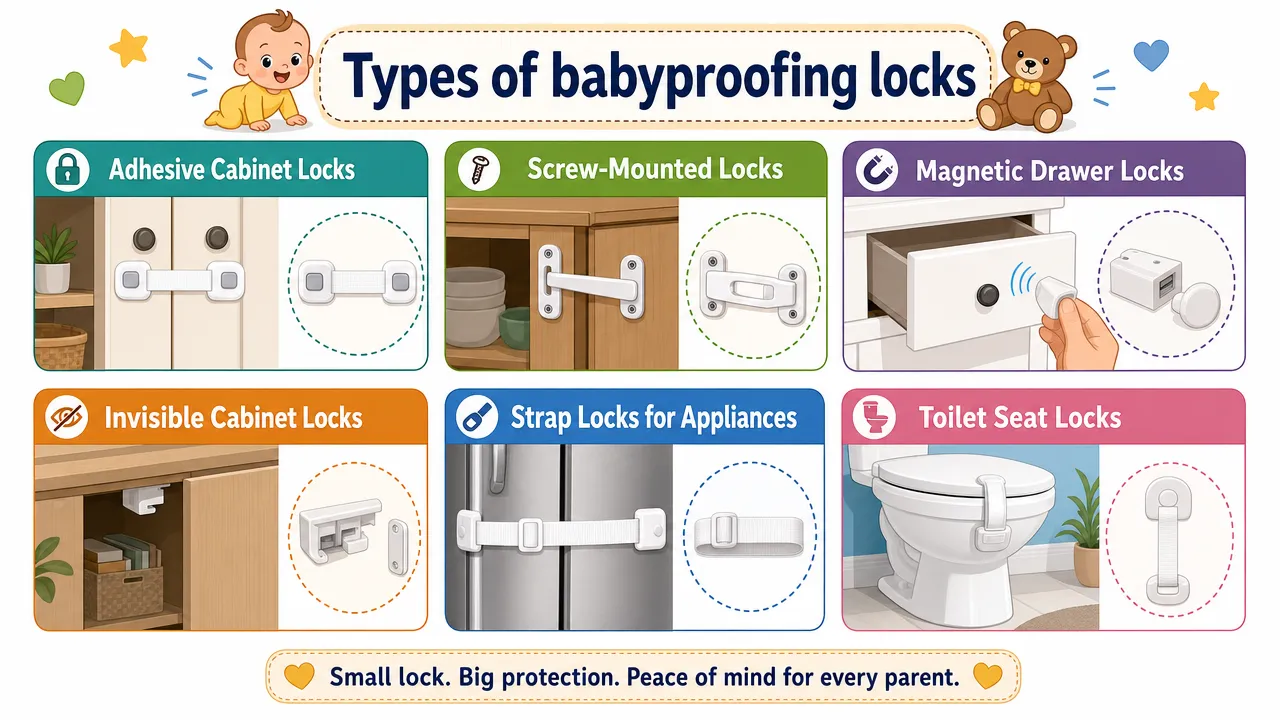
Magnetic cabinet locks are especially popular because they install inside the cabinet or drawer. When the door closes, the latch catches automatically. An adult uses a magnetic key from the outside to release the latch. Because the hardware is hidden, toddlers have fewer visual clues to copy. This is why many parents choose invisible cabinet locks for kitchens, bathrooms, pantries, and storage areas.
If you are comparing cabinet locks for babies, look at the surface and hazard level first:
| Lock type | Best use | Watch out for |
|---|---|---|
| Adhesive baby cabinet locks | Smooth cabinets, rentals, fast setup | Adhesive can fail if surface prep is poor |
| Screw-mounted locks | High-risk cabinets and permanent installs | Leaves holes and takes more work |
| Magnetic locks | Standard cabinets and drawers where hidden design matters | Alignment and key placement are important |
| Strap locks | Fridge, toilet, dishwasher, irregular cabinets | Visible from outside and child may learn the mechanism |
| Appliance locks | Oven, dishwasher, refrigerator | Must match appliance surface and heat exposure |
For standard kitchen and bathroom cabinets, Vmaisi magnetic systems are a strong fit when the cabinet material and thickness are compatible. The Vmaisi Adhesive Magnetic Cabinet Locks for Babies, 8 Locks and 2 Keys are designed for no-drill cabinet and drawer babyproofing. For families who want extra installation confidence, the Vmaisi Magnetic Child Safety Cabinet Locks 16 Pack is another related option to compare.
Do magnetic cabinet locks work on corner cabinets? Sometimes. Corner cabinets can be tricky because door angle, frame position, hinge movement, and interior spacing affect alignment. Before final installation, dry-fit the lock and catch, test the magnetic key through the door, and confirm the latch releases smoothly. If the corner layout prevents proper alignment, an external strap lock may be more practical.
Installing and removing home safety locks correctly
Even the best home safety locks can disappoint if they are installed incorrectly. Adhesive locks need clean, dry, smooth surfaces. Screws need careful measuring. Magnetic locks need precise alignment between the lock body, catch, and magnetic key position.
To learn how to install magnetic cabinet locks in more detail, Vmaisi offers a helpful guide on how to babyproof cabinets with magnetic locks. The general process is:
- Empty or clear the cabinet area.
- Check that the cabinet or drawer is compatible with a magnetic lock.
- Clean the mounting surface and let it dry fully.
- Dry-fit the lock and catch before sticking or screwing.
- Use the included guide, ruler, or template if provided.
- Attach the lock body and catch.
- Test the magnetic key before force testing.
- Wait the recommended adhesive cure time before relying on the lock.
- Store the magnetic key high and out of reach.
- Inspect the lock regularly.

How to remove magnetic cabinet locks depends on the mounting method. For adhesive-mounted locks, open or disable the lock first. Then work dental floss, fish line, or a plastic card behind the adhesive pad. Move slowly instead of prying with metal tools. If residue remains, use the least aggressive finish-safe method first and test any cleaner on a hidden area.
Cabinet locks with adhesive vs screws also differ after removal. Adhesive may leave residue or lift weak finishes. Screws leave holes and may require wood filler or touch-up. Neither method is damage-proof, so renters should always consider surface condition and lease requirements.
If you lose the magnetic key, do not leave cabinets unlocked while searching. Keep spare keys stored high and away from children. Vmaisi offers magnetic cabinet lock replacement keys, which can be useful for larger homes or grandparents' houses.
Room-by-room home safety locks for medicine, appliances, and bathrooms
The best home safety locks depend on the room. Start with the highest-risk zones, then work outward.
For kitchen cabinets, use magnetic locks for standard lower cabinets and consider screw-mounted or adhesive-plus-screw support for under-sink cleaners. Dishwasher detergent pods need special attention because the CPSC warns that they can cause poisoning or eye injuries. Read the CPSC dishwasher detergent pod guidance and store pods locked away, not just inside the dishwasher area.
For drawers, magnetic drawer locks are useful for utensils, knives, batteries, tools, gadgets, and small choking hazards. Child safety locks for drawers should be checked often because drawers get repeated pulling force.
For bathroom cabinets, use child safety cabinet locks on vanity doors and drawers that contain razors, cosmetics, cleaners, or medicine. To learn how to childproof a medicine cabinet, follow a layered plan: move medicines up high, keep them out of sight, lock the cabinet, keep medicines in original containers, relock caps, and save Poison Help at 1-800-222-1222. Vmaisi also has a dedicated guide on childproofing a medicine cabinet safely. The best child locks for medicine cabinet setups may include internal magnetic locks for wood cabinets, strap locks for mirrored or metal cabinets, and a lockable medicine box for high-risk prescriptions.
For child safety locks for fridge doors, external strap locks or fridge-specific locks usually fit better than internal magnetic locks because refrigerators are thick and often metal. For child safety locks for dishwasher doors, use an appliance or strap lock and keep detergent locked separately. For child safety locks for oven doors, use oven-rated locks and add stove knob covers where appropriate. The AAP burn prevention guidance also recommends keeping children away from hot cooking areas.
For child safety locks for toilet seat lids, use a toilet seat lock or a compatible multi-use strap lock. Toilets are a water and hygiene risk, and the CPSC drowning prevention guidance emphasizes that young children need close supervision around water. For more appliance planning, see Vmaisi's guide to child safety locks for dishwasher and appliances.
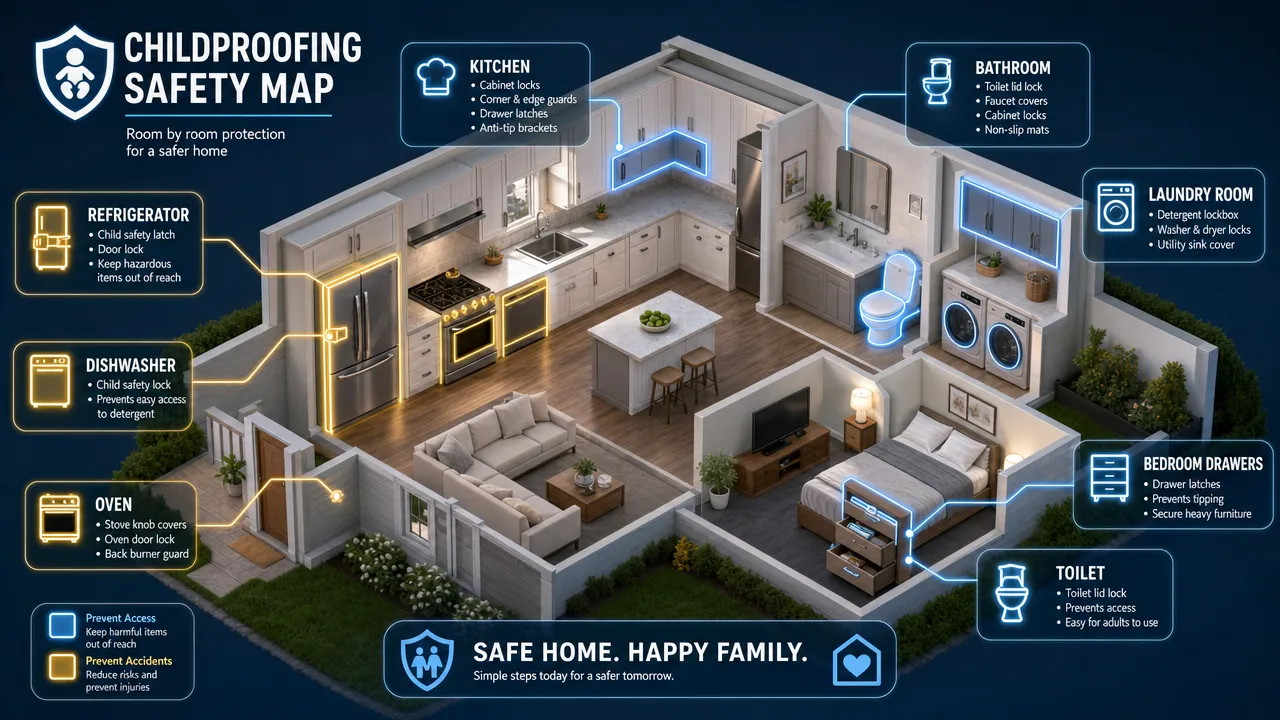
Final home safety locks recommendation
Choose adhesive home safety locks when you need fast, no-drill babyproofing on smooth, clean, dry surfaces. Choose screw-mounted locks when the cabinet contains high-risk items and permanent installation is acceptable. Choose magnetic cabinet locks and magnetic drawer locks when you want hidden, parent-friendly access for cabinets and drawers. Choose strap or appliance-specific locks for fridges, dishwashers, ovens, and toilet seats.
No lock makes a home completely childproof. Home safety locks, baby cabinet locks, baby proofing cabinet locks, and appliance locks reduce access to hazards, but they do not replace adult supervision, safer storage, and regular inspection.
Ready to babyproof your cabinets and drawers without changing the look of your home? Explore the Vmaisi Child Safety Magnetic Drawer & Cabinet Locks 20 Pack for hidden cabinet and drawer protection. If you want to compare an option with adhesive and screw-supported positioning, review the Vmaisi Magnetic Child Safety Cabinet Locks 16 Pack.
Quick FAQ:
| Question | Short answer |
|---|---|
| Are adhesive child safety locks strong enough? | Yes, for many compatible surfaces when installed correctly and allowed to cure. Use stronger options for high-risk cabinets. |
| Are screw-mounted cabinet locks safer? | They offer stronger mechanical attachment, but safety also depends on storage habits, supervision, and installation quality. |
| How to baby proof cabinets and drawers? | Prioritize hazards, use magnetic locks for standard cabinets and drawers, and use strap locks where internal locks do not fit. |
| Are invisible cabinet locks reliable? | They can be reliable when aligned correctly, used on compatible doors, and checked regularly. |
| Can locks replace supervision? | No. They are safety aids, not substitutes for adult attention. |