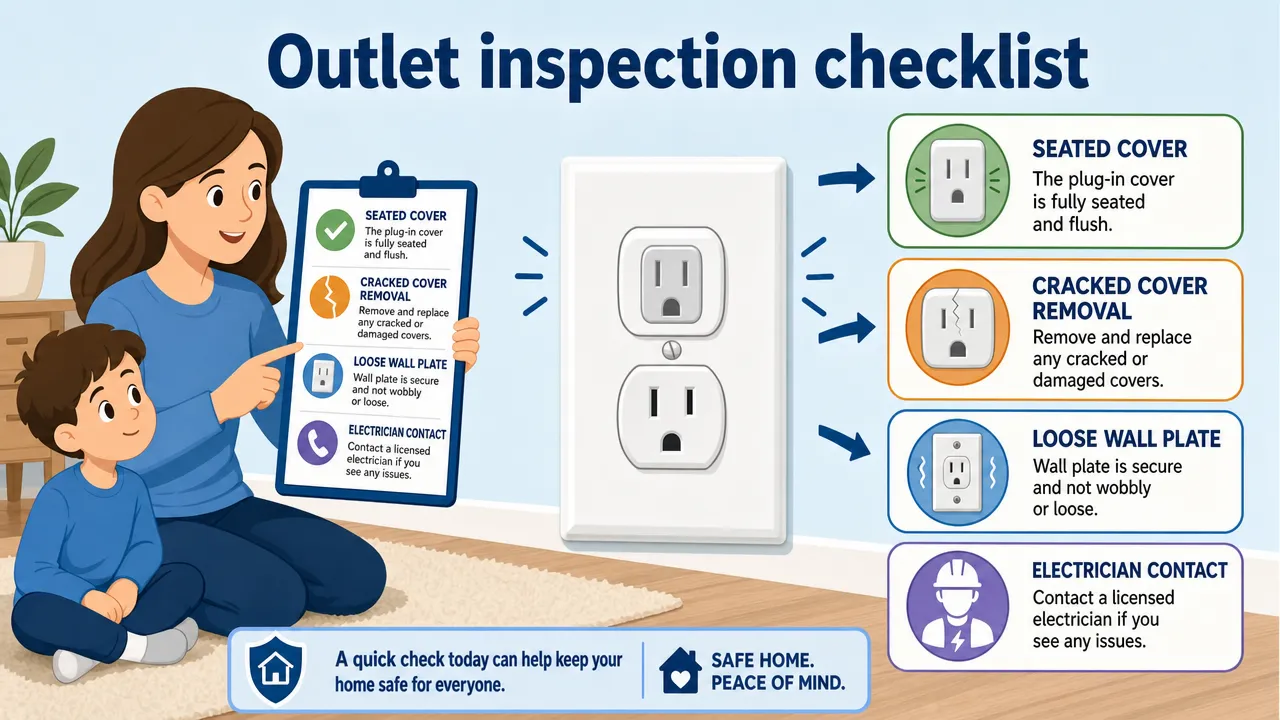
How to Inspect Outlet Covers as Your Child Grows
A plug-in cover needs reassessment when your child's abilities or daily access change. Use behavior and household events as prompts for a visual check rather than relying on a fixed age or calendar interval.
Look again when your child starts reaching a new wall area, pulling on nearby furniture or cords, returning repeatedly to an outlet, carrying small objects, or copying adults who plug in equipment. The Electrical Safety Foundation International notes that removable outlet caps can be defeated by young children, which supports a behavior-based approach instead of an age cutoff.
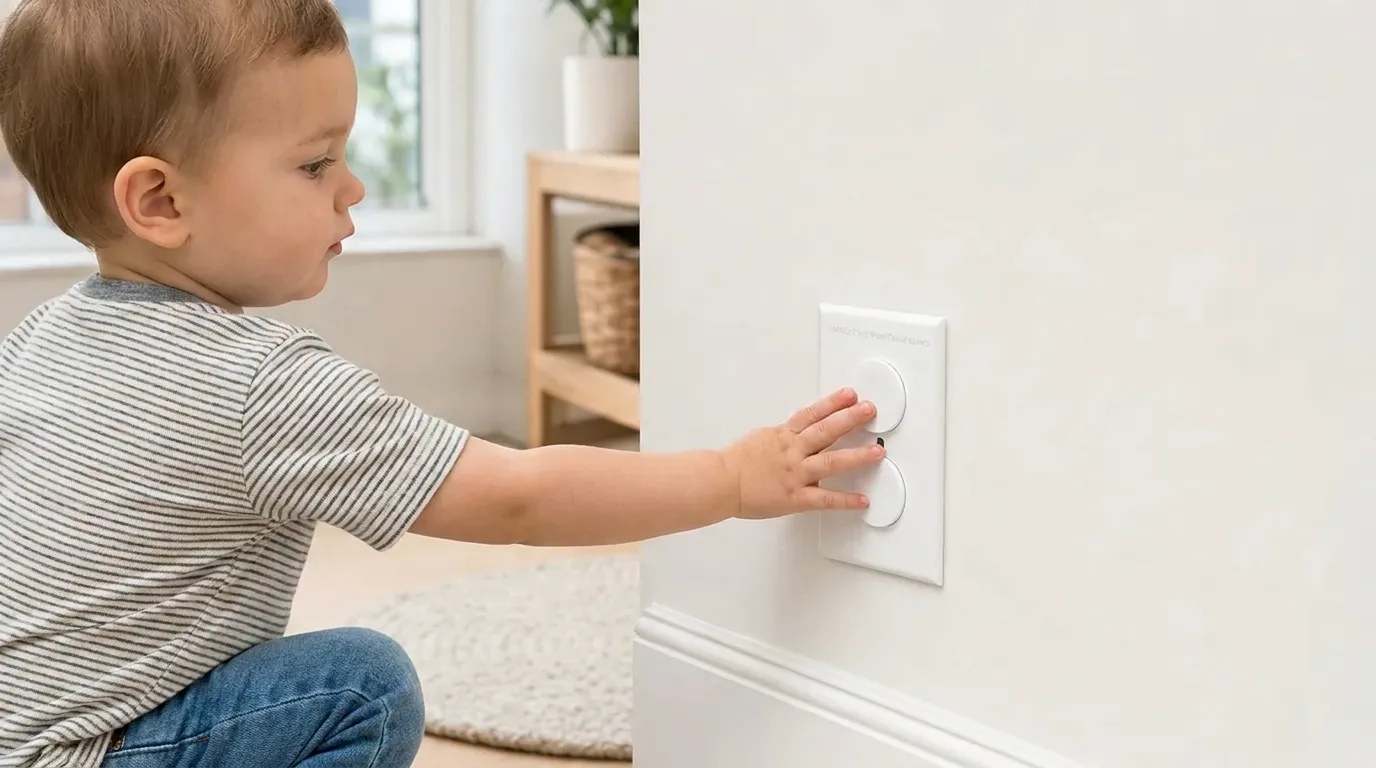
Recheck the setup when your child's behavior changes
Observe what your child can do now. A cover that was ignored earlier may attract attention after your child gains coordination, reach, grip strength, or persistence.
Use these behavior changes as inspection triggers:
- Your child reaches an outlet that was previously out of reach.
- Your child pulls at cords, furniture, or objects near a wall receptacle.
- Your child touches the cover, pinches its edge, or tries to pull it out.
- Your child returns to the same outlet after being redirected.
- Your child imitates plug-in routines.
- Your child carries small objects into rooms with accessible outlets.
Do not repeatedly challenge a cover to see if it will come out. Observe normal use and your child's actions. If your child removes a cover once, treat that cover as unsuitable for that location.
A plug-in outlet cover can add a layer of protection for an appropriate unused outlet. It does not replace active supervision or electrical repair.
Check the cover's condition and fit
Check the cover and its fit before deciding it can remain in service. Look in good light. Inspect the visible edges, face, and seating against the receptacle.
A cover should appear fully seated. It should not sit tilted, project noticeably from one side, or slip outward during ordinary observation. Do not force a cover deeper into the receptacle.
Remove the cover from service if your child can remove it, it is loose, cracked, distorted, incomplete, or no longer remains seated. Keep the removed cover away from children.
Do not use a damaged or rejected cover again. Do not bend, reshape, trim, tape, glue, or otherwise modify it. Do not use tools or probes to assess the outlet.
Check each accessible unused receptacle separately. A cover that remains seated in one room may not fit reliably in another receptacle. Receptacles can vary because of wear, age, or condition.
Use this decision table during a visual inspection.
| What you see | Required action |
|---|---|
| Cover is intact and fully seated | Continue using it only as supplemental protection in that compatible, undamaged, unused receptacle. |
| Cover is loose or slips out | Remove it from service in that receptacle. Do not force or modify it. |
| Cover is cracked, distorted, or incomplete | Remove it from service and keep it away from children. |
| Child removes the cover | Remove it from service in that location. Consider a different long-term approach. |
| Cover blocks an outlet needed for normal appliance use | Remove the cover for intended appliance use and keep it away from children. |
For a cover that feels loose, use the specific steps in what to do if an outlet plug cover feels loose. A loose accessory does not prove that the receptacle is defective, but it does mean the cover is not dependable in that location.
Look at the receptacle, not just the cover
Look beyond the plug-in cover. A cover cannot correct a damaged wall plate, worn receptacle, loose electrical device, or wiring problem.
Stop using the affected outlet and contact a qualified electrician if the receptacle or wall plate is:
- Loose, cracked, broken, or missing.
- Warm or hot.
- Discolored or marked by scorching.
- Buzzing or making unusual electrical sounds.
- Sparking.
- Producing a burned smell.
- Causing a shock or tingle.
- Failing to hold an ordinary appliance plug securely during normal use.
The U.S. Consumer Product Safety Commission guide to home wiring hazards identifies loose plugs, heat, buzzing, sparks, burned odors, and shocks or tingles as warning signs that require corrective action.
Do not diagnose the cause. Do not open the wall plate, tighten electrical parts, test the receptacle with tools, or attempt wiring work. A plug-in cover is not a repair device.
If you rent, promptly report the condition to the landlord, property manager, or designated maintenance contact. Stop using the outlet until it receives appropriate attention.
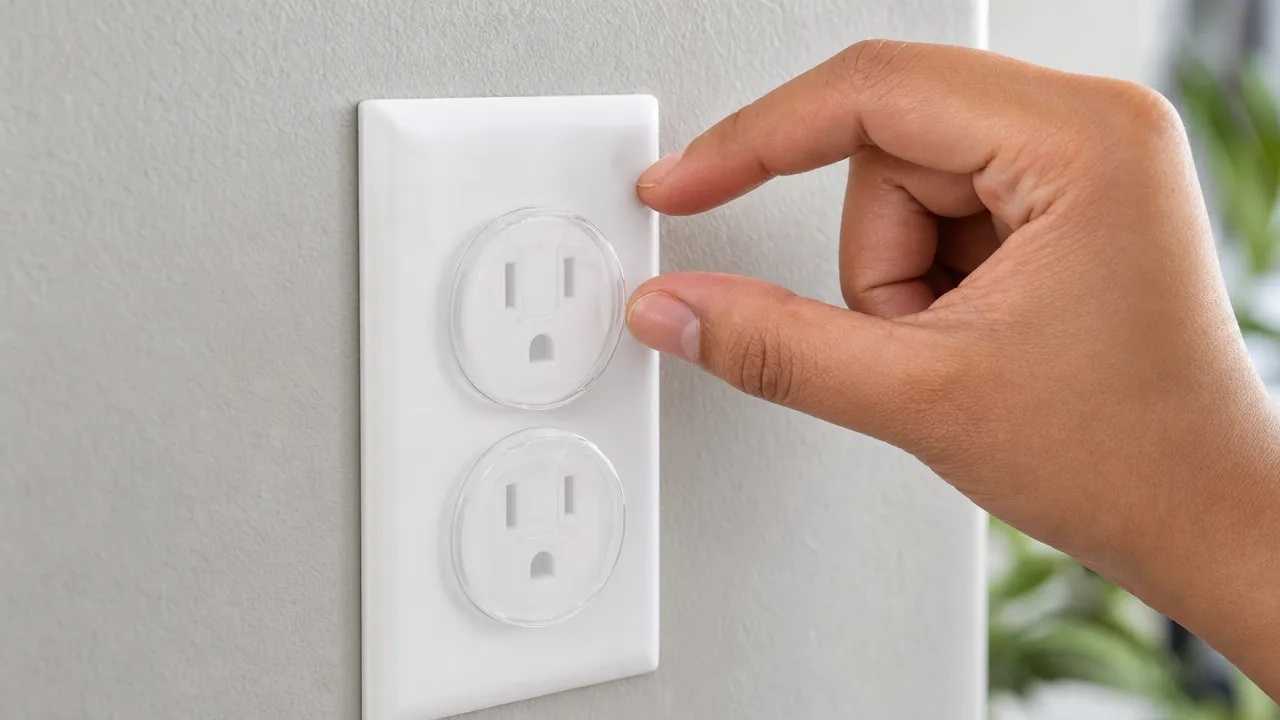
Pay extra attention to clear covers and busy outlets
Pause at clear covers and look specifically for the cover and its outer edge. Transparent covers can blend into the receptacle and wall area. This is a practical visual-check habit, not a claim that clear covers are less secure.
Give extra attention to outlets that adults use often. A cover may be removed for a lamp, charger, cleaning equipment, or another appliance. Repeated handling creates opportunities for a cover to be left off, misplaced, damaged, or reinserted without a reliable fit.
After appliance use, confirm that an unused receptacle has the appropriate cover in place only if the outlet is compatible, undamaged, and the cover remains seated. Keep any removed cover away from children.
Cleaning and furniture movement are also useful inspection prompts. Check outlets again after you:
- Vacuum or deep-clean near walls.
- Move a sofa, bed, table, or shelving.
- Rearrange a child's room.
- Unplug or relocate equipment.
- Find a cover on the floor or under furniture.
- Change which outlets are used regularly.
Use these events as reminders. They are not mandatory inspection intervals.
For related visual considerations, see clear versus white outlet covers. Keep the safety decision separate from appearance: fit, condition, child access, and receptacle condition control whether a plug-in cover should remain in use.
Decide what to do when the setup no longer works
Use a plug-in cover only for a compatible, undamaged, unused receptacle. The Vmaisi Plug-In Outlet Cover is supplemental protection for a compatible, undamaged, unused receptacle and does not replace supervision or electrical repair.
Ask a qualified electrician about tamper-resistant receptacles when removable covers are no longer reliable, your child can remove them, or an accessible outlet is used frequently. Tamper-resistant receptacles have built-in shutters that remain closed unless a proper plug applies pressure to both slots at the same time. They are different from removable plug-in covers. ESFI's explanation of tamper-resistant receptacles provides additional context.
A tamper-resistant receptacle does not override electrical warning signs. Stop using an outlet and seek qualified help if you notice heat, movement, damage, discoloration, buzzing, sparks, burned odors, or shocks.
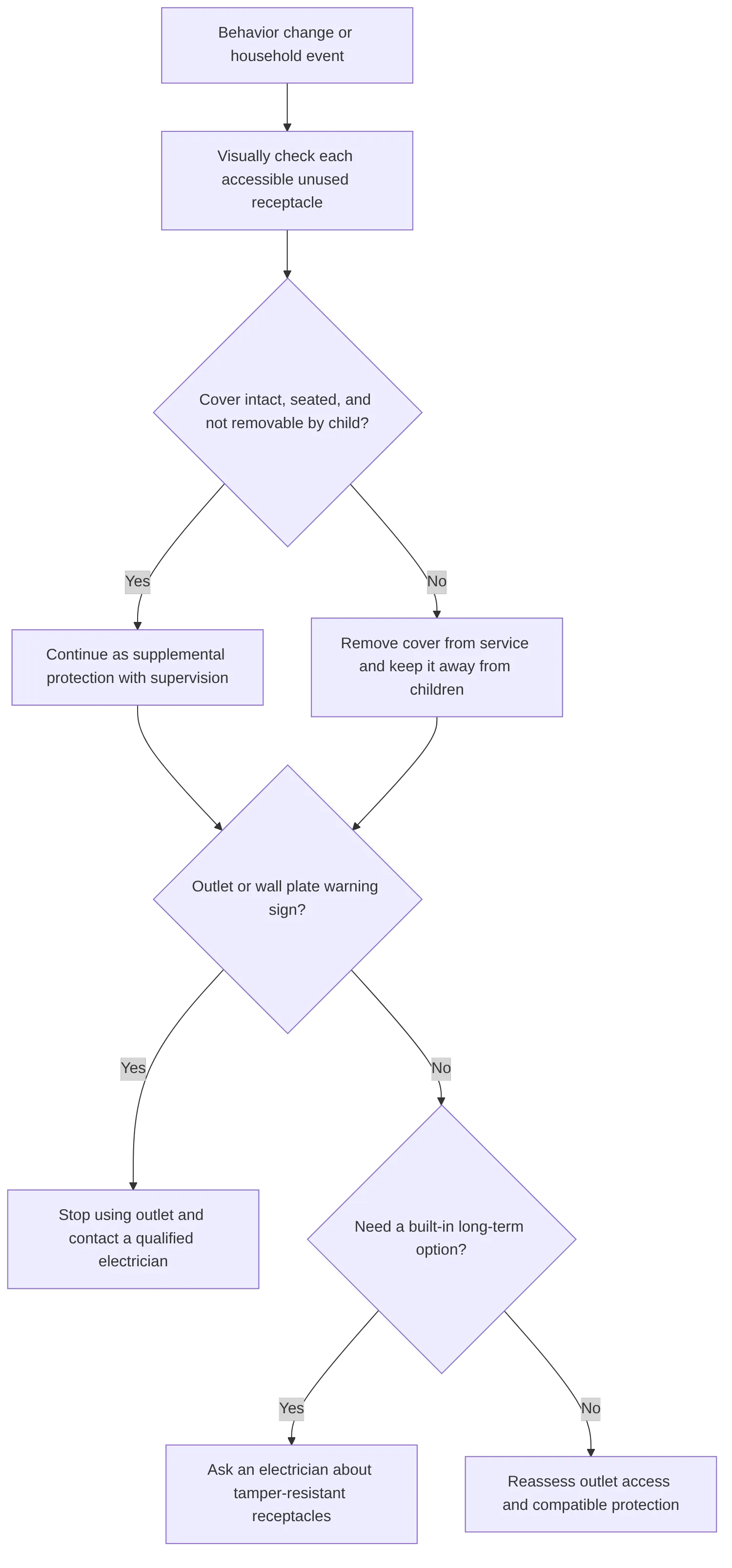
Use when to stop using plug-in outlet covers when a child's behavior, a cover's condition, or an outlet's daily use changes the decision.
Keep a simple inspection checklist
Use this checklist after a new behavior, an outlet-related concern, cleaning, furniture movement, appliance relocation, or a cover found out of place.
- Look at each accessible unused receptacle individually.
- Confirm the cover is present, intact, fully seated, and not loose.
- Check that your child has not removed or repeatedly manipulated the cover.
- Look deliberately at clear covers and their edges.
- Review high-use outlets after a cover has been removed and reinserted.
- Check the wall plate and receptacle for cracks, movement, damage, heat, discoloration, buzzing, sparks, or a burned smell.
- Stop using an outlet if an ordinary plug will not remain seated during normal use.
- Remove any cover that is loose, cracked, distorted, incomplete, child-removable, or no longer seated.
- Keep removed covers away from children.
- Contact a qualified electrician for outlet damage, warning signs, or uncertain conditions.
- Continue active supervision. Outlet covers do not replace supervision or electrical repair.