

60 vs 100 Piece Magnetic Tiles: Which to Buy?
Are you trying to decide whether a 60-piece or 100-piece set of magnetic tiles for kids is enough for your child's building ideas? If so, the practical answer is simple: choose 60 pieces for a first set, one child, smaller spaces, or a tighter budget. Choose 100 pieces if your child already loves building, if siblings will share, or if you want more long-term creative and educational play.
Both set sizes can support hands-on fun, shape recognition, color sorting, fine motor practice, and STEM-style play. The difference is how much building freedom your child has before running out of pieces.

Quick answer for magnetic tiles for kids: 60 or 100 pieces?
For most families, a 100-piece magnetic tile set offers the better long-term value. It gives children more room to build castles, garages, towers, houses, vehicles, pretend-play cities, and collaborative projects. If you have more than one child, 100 pieces usually feels much more practical.
A 60-piece set still makes sense when you are buying your first magnetic tiles toy, shopping for one younger child, managing storage space, or testing whether your child enjoys magnetic building tiles. It is enough for simple structures, beginner STEM activities, color sorting, and shape recognition.
If you want to compare available set sizes in one place, explore YRZtiles Kids Magnetic Tiles Educational Toys, which are designed for open-ended building, creativity, geometry awareness, spatial reasoning, and parent-child play.
| Choose this set size | Best for | Main advantage | Possible limitation |
|---|---|---|---|
| 60 pieces | One child, first-time buyers, smaller spaces | Lower upfront cost and easier cleanup | May feel limited for large builds or siblings |
| 100 pieces | Siblings, bigger builds, gift buyers, long-term play | More creative freedom and stronger play value | Needs more storage and cleanup time |
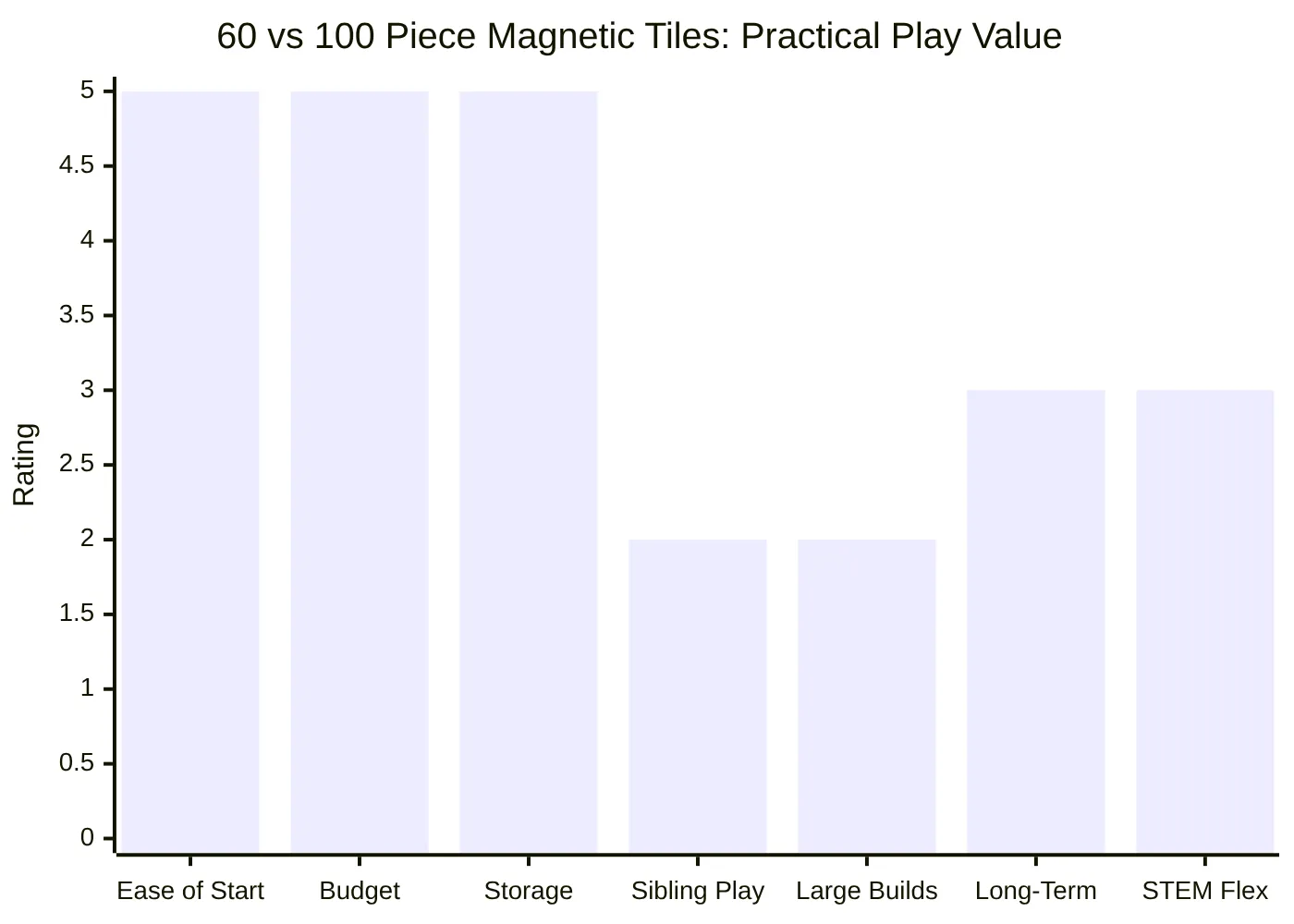
The chart above reflects the typical strengths of a 60-piece starter set: it is easy to begin with, easier to store, and often more comfortable for a younger child who is just learning how magnetic tiles connect. However, once children want to build taller, wider, or more detailed structures, the smaller set can feel restrictive.
What magnetic tiles for kids are and how they support play
Magnetic tiles for kids are colorful geometric pieces with magnets enclosed along the edges. Children connect the edges to build flat patterns or 3D structures, such as houses, bridges, towers, roads, castles, animals, and pretend-play scenes. Because the pieces connect quickly, children can build, test, knock down, and rebuild without much frustration.
This is why kids magnetic tiles are often described as an open-ended educational building toy. There is no single correct outcome. A square can become a wall, a floor, a window, or part of a robot. A triangle can become a roof, a ramp, or part of a pyramid.
The National Association for the Education of Young Children notes that open-ended toys can encourage creativity, reasoning, discovery, and imagination. You can read more in NAEYC's guidance on choosing meaningful toys for young children.
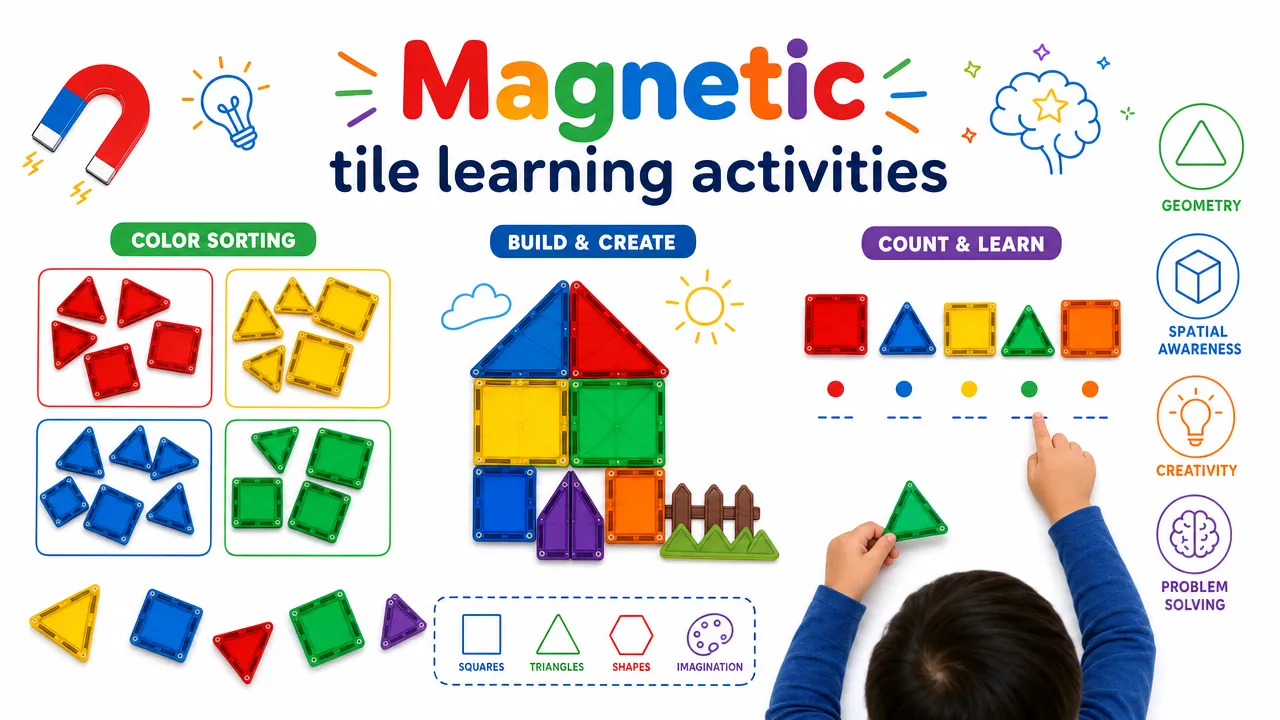
For parents, magnetic building tiles are especially useful because they can turn playtime into simple learning moments:
- "Can you sort all the blue tiles?"
- "What shape should we use for the roof?"
- "How can we make this tower stronger?"
- "Can you build the same house with different colors?"
- "How many squares did we use?"
These small questions support shape recognition, color recognition, early math language, problem-solving, and parent-child interaction.
When 60-piece magnetic tiles for kids make sense
A 60-piece set is a smart starting point if you are buying magnetic tiles for 3 year olds or preschoolers who are new to building toys. It gives children enough pieces to learn how the tiles connect and to build simple houses, towers, fences, ramps, small castles, and basic shapes.
A 60-piece set is also helpful when you want less clutter. Fewer pieces mean cleanup is faster, storage is easier, and the play area stays more manageable. For apartments, grandparents' homes, small play corners, or families who want a first magnetic tiles educational toy without overbuying, 60 pieces can be enough.
A 60-piece set is best if:
- You are buying for one child.
- This is your child's first magnetic tiles toy.
- Your child is still learning basic building skills.
- You want a lower upfront cost.
- You have limited storage space.
- You mainly want color sorting, shape recognition, and simple builds.
- You may expand later if your child enjoys the toy.
The main drawback is that children can run out of pieces quickly when they start building larger structures. A child may use most of a 60-piece set on one house or tower. If a sibling joins in, there may not be enough favorite shapes to share.
Still, magnetic tiles 60 pieces can be a practical and parent-friendly choice for beginner play. If your child enjoys blocks, puzzles, pretend play, or simple STEM toys for kids, a 60-piece set can be a gentle introduction before moving to a larger set later.
When 100-piece magnetic tiles for kids are worth it
A 100-piece set is usually the stronger choice when you want longer-term play value. Magnetic tiles 100 pieces give children more flexibility to build larger structures, experiment with stability, and create more detailed pretend-play worlds. This matters because magnetic building play often grows with the child.
A 3-year-old may begin with simple squares and triangles. A preschooler may build houses, garages, and castles. An early elementary child may start testing bridges, towers, symmetry, 3D shapes, and more advanced building challenges. A larger set supports this progression better.
A 100-piece set is best if:
- You have two or more children.
- Your child already enjoys building toys.
- You want a gift that feels more complete.
- You want more parent-child building activities.
- Your child likes large castles, towers, vehicles, or cities.
- You want more STEM-style challenges.
- You prefer buying one more flexible set instead of expanding soon.
For siblings, 100 pieces can make a big difference. Children can divide pieces, build side-by-side, or work together on one larger structure. This can encourage cooperation, planning, and communication. It also reduces the frustration that happens when one child uses most of the tiles before another child gets started.
Parents who want a magnetic tiles educational toy for repeated use often find that 100 pieces offer more room to grow. The larger set may cost more upfront, but it can feel more useful over time because children have fewer limits during creative building.
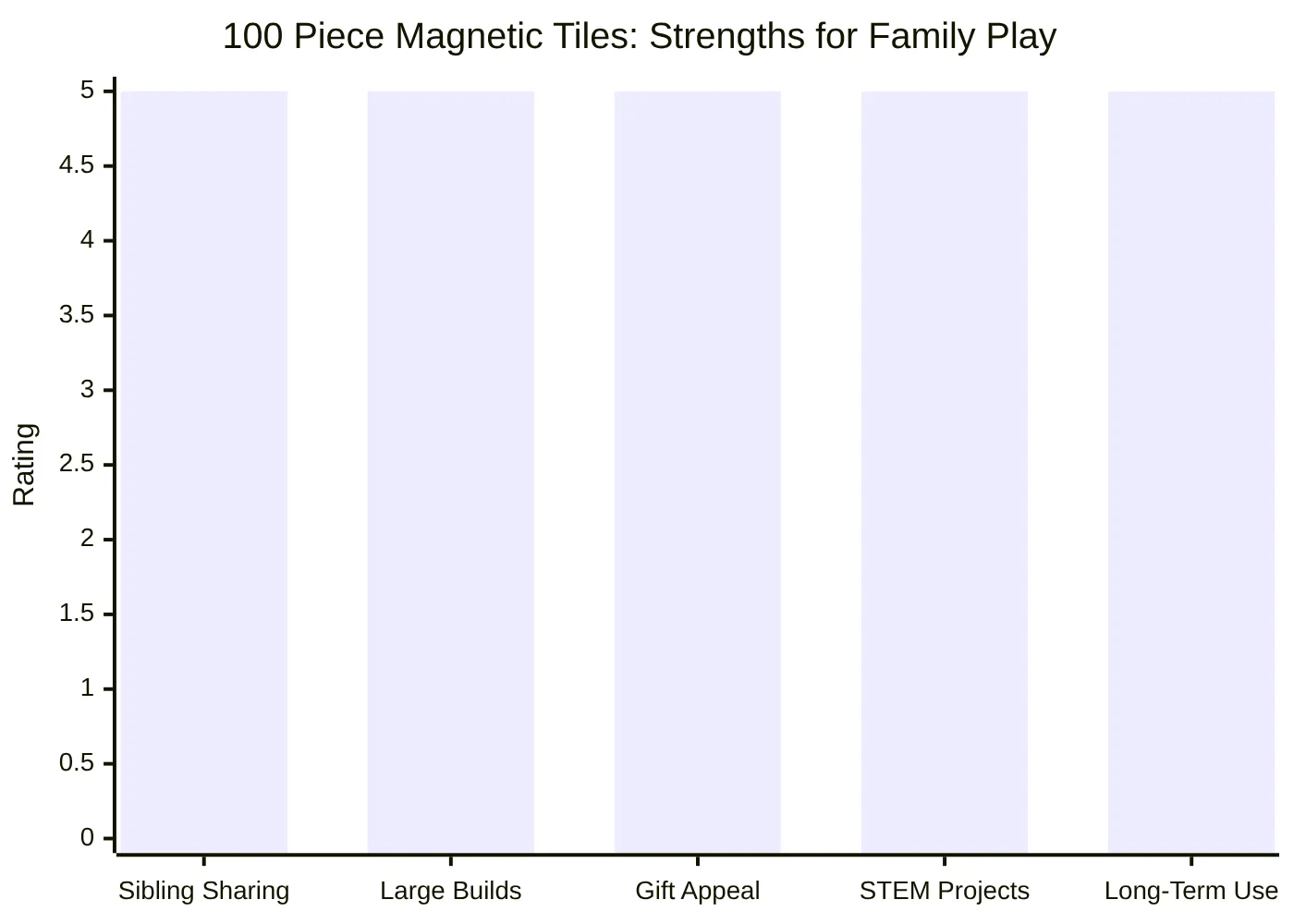
This second chart focuses only on the strengths of a 100-piece set. While it may require a larger storage bin and a more consistent cleanup routine, the extra pieces often pay off through richer builds, longer play sessions, and better group play.

Best magnetic tiles for kids by age and household
The best set size depends on your child's age, development, and play situation. Safety and supervision also matter, especially for younger children.
| Age or household | Better choice | Why |
|---|---|---|
| Toddlers | 60 pieces, if age-appropriate and supervised | Fewer pieces are easier to manage for simple guided play |
| 3-year-olds | 60 or 100 pieces | 60 is good for beginners; 100 is better if the child loves building |
| Preschoolers | 100 pieces | More pieces support houses, towers, patterns, and pretend play |
| Early elementary children | 100 pieces | Better for complex structures and geometry activities |
| Siblings | 100 pieces | More pieces reduce competition and support cooperation |
| Gift buyers | 100 pieces | Often feels more complete and exciting |
For magnetic tiles for toddlers, always follow the manufacturer's age label. Many magnetic tile products are designed for ages 3 and up, and younger children need close supervision. If a child still mouths toys, parents should be especially careful.
For magnetic tiles for 3 year olds, a 60-piece set can be a strong starter option. However, if your child already likes blocks, stacking toys, or pretend-play construction, 100 pieces may be the better long-term choice.
For safety, the U.S. Consumer Product Safety Commission warns that swallowed magnets can be dangerous, especially if more than one magnet is swallowed. Parents should review the CPSC's magnet safety guidance and the American Academy of Pediatrics' parent guidance on magnetic toy hazards.
Practical safety habits include:
- Follow the product age label.
- Supervise younger children.
- Inspect tiles regularly.
- Remove cracked or damaged pieces immediately.
- Keep loose magnets away from children.
- Store the set after playtime.
- Seek medical guidance immediately if a magnet may have been swallowed.
Educational benefits of magnetic tiles for kids
Magnetic tiles for kids are not just colorful building pieces. Used thoughtfully, they can support several early learning areas through play. NAEYC's discussion of block play and STEM learning explains how construction play can connect to early math, science, and problem-solving. Magnetic tiles work in a similar way because children test balance, shape, position, and structure.
| Learning area | How magnetic building tiles help |
|---|---|
| STEM learning | Children test balance, stability, structure, and cause and effect |
| Geometry awareness | Children use squares, triangles, rectangles, angles, symmetry, and 3D forms |
| Spatial reasoning | Children rotate, align, stack, and connect pieces |
| Fine motor skills | Children grasp, place, separate, and reposition tiles |
| Creativity | Children build open-ended designs without one fixed answer |
| Problem-solving | Children rebuild when a tower falls or a roof does not fit |
| Parent-child play | Adults can guide challenges, ask questions, and build together |
A 60-piece set can support simple versions of these activities. A 100-piece set expands what children can try. For example, with 60 pieces, a child might build one house and sort the remaining shapes. With 100 pieces, the same child might build a house, garage, road, tower, and animal pen in one play session.
That is why parents looking for a magnetic tiles educational toy often prefer a larger set if budget and storage allow. More pieces do not automatically make a toy more educational, but they do create more opportunities for experimentation, collaboration, and open-ended play.
How to choose YRZtiles magnetic tiles for kids
If you are choosing between magnetic tiles 100 pieces and magnetic tiles 60 pieces, use this simple decision guide:
Choose 60 pieces if you want a starter set for one child, your child is new to magnetic tiles, storage space is limited, or you want a smaller first purchase.
Choose 100 pieces if you have siblings, your child already likes building toys, you want larger structures, or you are buying a birthday or holiday gift with more long-term play potential.
For families comparing set sizes, YRZtiles Kids Magnetic Tiles Educational Toys are a natural option to consider. They support creative building, STEM-style exploration, geometry awareness, spatial reasoning, fine motor practice, and parent-child activities. You can also view the YRZtiles magnetic tiles product page for more product details.
Final recommendation
If you are buying for one younger child and want to start simple, 60 pieces are enough. If you want the best all-around value for siblings, larger builds, gifts, and longer-term educational play, choose 100 pieces.
For most families, the 100-piece set is the better long-term choice. But the best magnetic tiles for kids are the ones that fit your child's age, your home, your storage space, and the way your family actually plays.