

Magnetic Tile Gift Guide for Preschoolers
Are you trying to find a magnetic-tile gift that feels exciting for a preschooler, while also fitting your family's expectations for age-appropriate, hands-on play? This magnetic tile gift guide for preschoolers helps you compare the details that matter most: the exact age label, product information, building scope, storage needs, and a simple routine for responsible use.
For this guide, preschoolers means children ages 3 to 5. However, the age grade, warnings, and instructions on the exact set always come first.
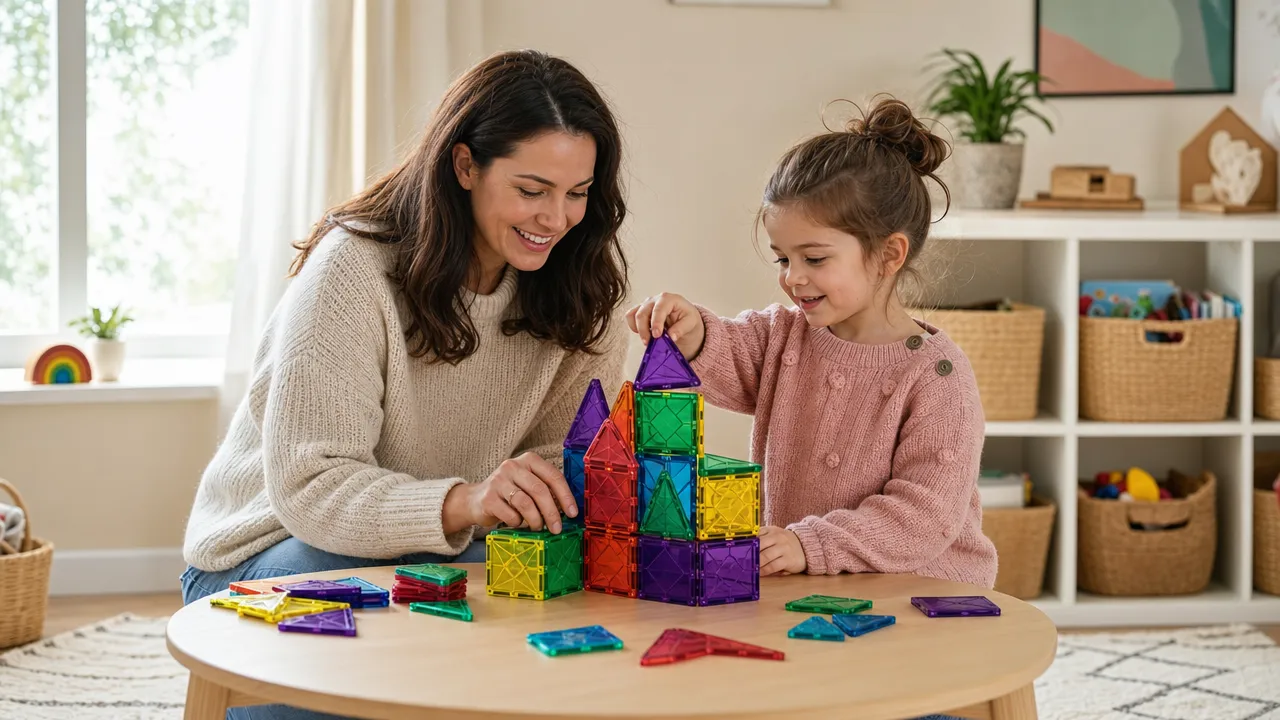
Why a magnetic tile gift guide for preschoolers starts with play value
Magnetic tiles are open-ended construction toys that let children connect flat shapes into patterns, towers, houses, bridges, and imaginative scenes. For many families, they are appealing because one set can support quiet solo play, shared sibling building, and parent-child activities.
Construction play can offer opportunities to practice shape recognition, balance, comparison, spatial language, storytelling, and collaborative problem-solving. The National Association for the Education of Young Children explains that block play can introduce children to ideas such as symmetry, measurement, spatial sense, and balance. Read NAEYC's guidance on what children learn through block play.
That does not mean any set guarantees a specific learning outcome. Instead, kids magnetic tiles can give preschoolers a practical way to explore questions such as:
- Which shape makes a sturdy base?
- Can two triangles create a new shape?
- What happens when a roof will not balance?
- How can we make the two sides of a design match?
- What story can this building become?
A study of young children's construction play found an association between more complex block building at age 3 and later spatial skills. It is a useful reason to encourage building experiences, not a promise that a particular toy will produce a particular result. Review the peer-reviewed study on block-building complexity and spatial skills.
For a first gift, look for a set that invites experimentation rather than requiring a child to build only one model. A few simple parent prompts can make open-ended play easier to begin:
- "Which shape could make a point on top?"
- "How can we make this wall taller?"
- "What could go inside your pretend home?"
- "Can you build the same pattern on both sides?"
How to use this magnetic tile gift guide for preschoolers safely
Start with the exact product page or package, not a general preschool label. Some magnetic tiles educational toys are labeled ages 3+, including the current YRZtiles educational toy listing, but parents should verify the live age grade, warnings, and instructions for the specific set they plan to give.
Follow the label and supervise for your household
The right level of supervision depends on the child's habits, the product instructions, and whether younger children can access the play area. Closer adult involvement is especially important if a child still mouths toys or if a younger sibling may pick up pieces.
Before the first build:
- Read the age label, warnings, and instructions.
- Inspect each visible tile for cracks, splits, sharp edges, missing pieces, or loose parts.
- Build together at first, so the child learns a gentle-use and cleanup routine.
- Store the set in a consistent place after play.
The American Academy of Pediatrics advises parents to check magnet-containing toys regularly for cracks where a magnet could become loose. See HealthyChildren.org guidance on magnetic toy risks.
Intact magnetic building tiles are different from loose or separated magnets. Still, if a tile is damaged or a component appears loose, remove it from play immediately. Do not try to repair it for continued use.
If you suspect a child has swallowed one or more magnets, seek immediate medical attention. Do not wait for symptoms. Read the U.S. Consumer Product Safety Commission magnet safety guidance.
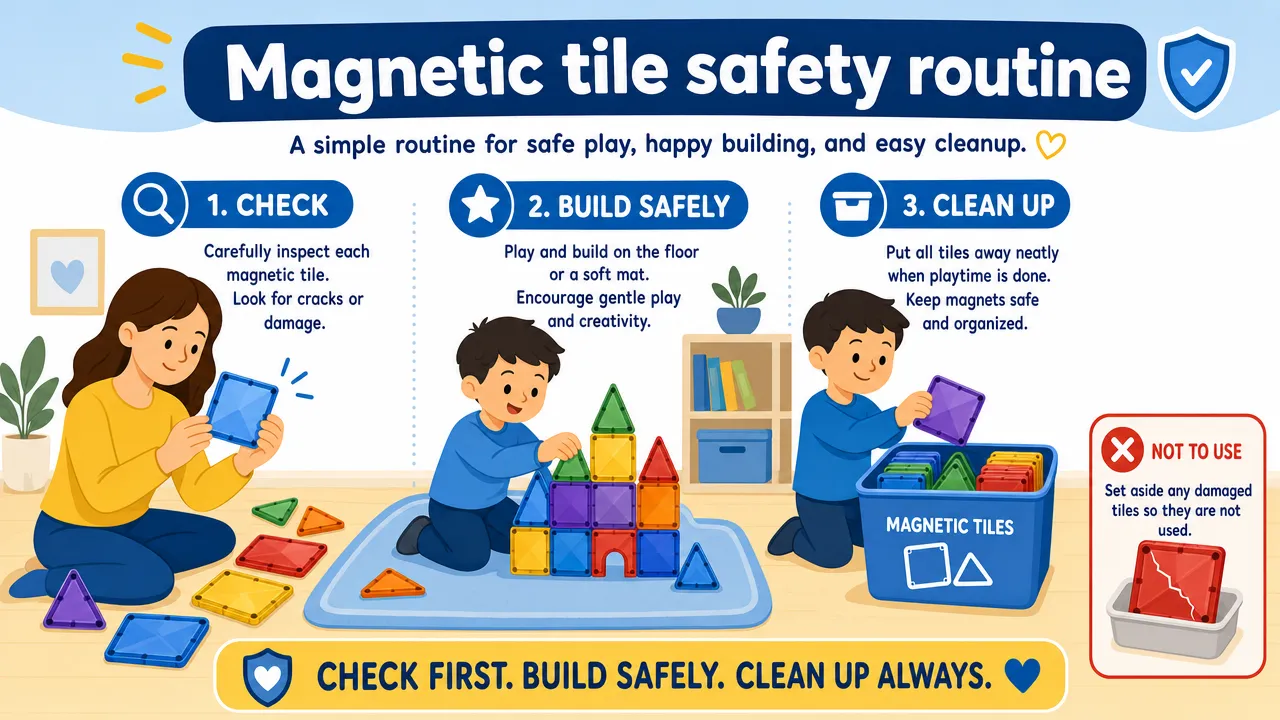
Make inspection part of cleanup
A simple "build, check, store" routine is more useful than treating inspection as a one-time unboxing task.
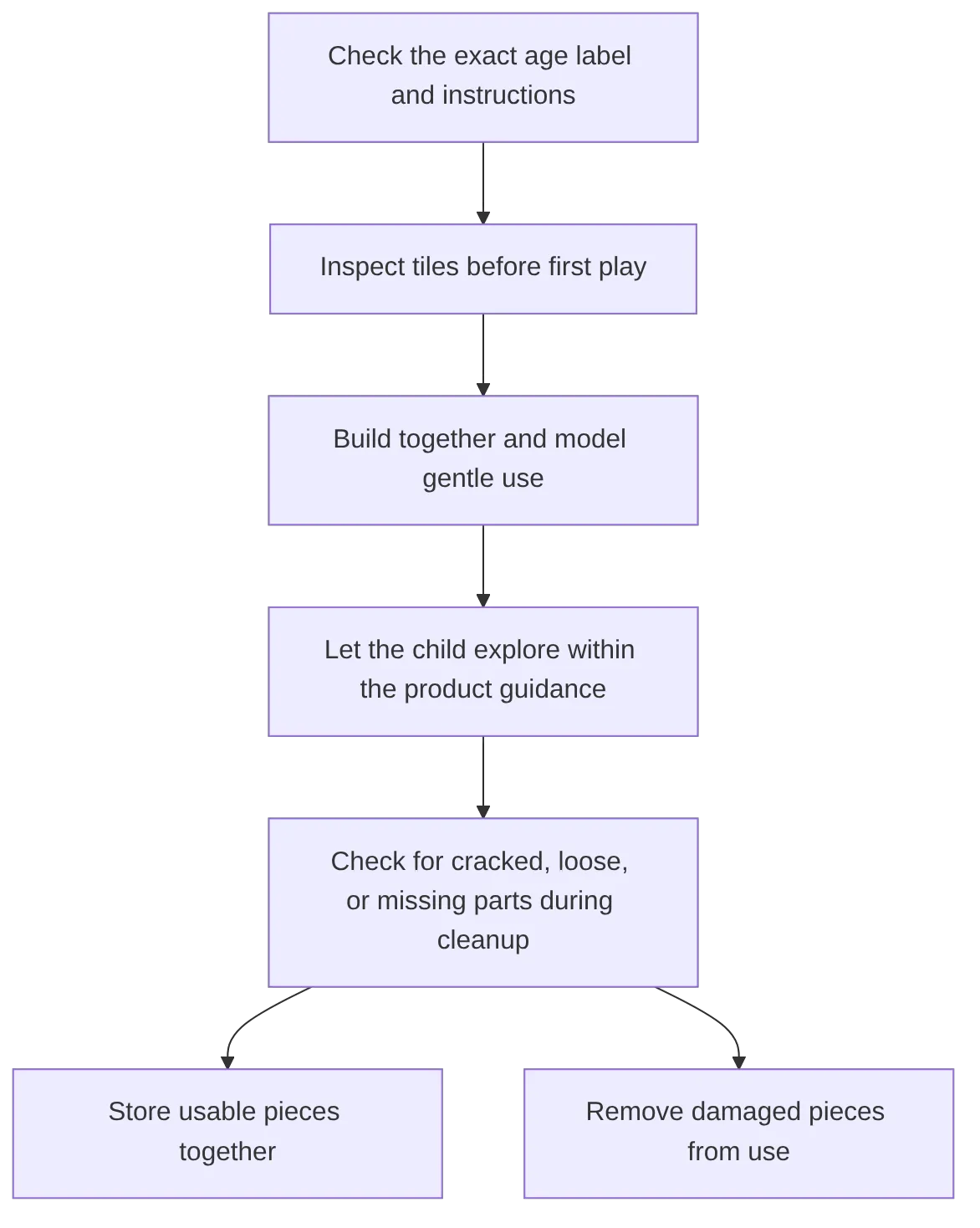
What to compare in a magnetic tile gift guide for preschoolers
A larger piece count is not automatically a better choice. The best magnetic tile gifts for 3 year olds, 4 year olds, and 5 year olds depend on the child's interests, available storage, likely play partners, and the actual contents of the set.
| What to compare | Why it matters | What to check |
|---|---|---|
| Age grade | Confirms the maker's intended user range | Exact listing and package label |
| Warnings and instructions | Helps you plan responsible use | Product page, packaging, and support details |
| Condition and construction information | Supports an informed purchase and inspection routine | Clear manufacturer or seller information |
| Shape mix | Influences what a child can build | Contents list, product photos, and included pieces |
| Gift scope | Helps match the set to first play, travel, or shared building | More than piece count alone |
| Storage | Makes cleanup and regular checks easier | Included storage only if specifically verified |
| Compatibility | Matters for expansion gifts | Current manufacturer documentation only |
For a first magnetic tile set, a manageable collection with a clear contents list can be a practical choice. Preschoolers often enjoy foundational shapes because they can make flat pictures, simple structures, and early 3D designs without needing specialty accessories.
For children who already build often or play with siblings, a broader collection may provide more room for side-by-side building and larger structures. If you are deciding between different scopes, VMAISI's guide to comparing 60-piece and 100-piece magnetic-tile sets can help you think beyond the number on the box.
Do not assume two sets with the same piece count include the same shapes. One may focus on basic geometric forms, while another may contain a different mix that changes the building experience.
First gift, expansion, or travel choice
Use the child's play context to narrow the options:
- First gift: Choose clear age information, visible contents, and a manageable storage plan.
- Open-ended building gift: Look for foundational shapes that support many possible builds.
- Guided activity gift: Consider prompts or idea cards if the child enjoys a starting challenge.
- Travel-friendly gift: Prioritize a contained scope that is easy to check and store.
- Shared-play gift: Consider more building room and a shape mix that supports multiple builders.
If you are comparing current YRZtiles options, review the specific listing rather than relying only on a general description. A smaller-scope YRZtiles option may suit contained play, while a broader YRZtiles building option may offer more room for collaborative projects. Check each current page for age guidance, included pieces, and warnings before choosing.
Compatibility should never be assumed between brands. Verify it only through current manufacturer information for both the existing set and the proposed expansion.
Magnetic tile gift guide for preschoolers by play style
The most thoughtful gift is one that meets a preschooler where they are now, rather than one chosen only because it has the highest piece count or the boldest marketing language.
For a child who likes to invent
Choose magnetic building tiles that leave room for the child to change plans. A child may begin by building a square house, turn it into a garage, then rebuild it as an animal shelter. This flexibility supports creativity and storytelling without making the activity feel like a test.
Helpful parent prompts include:
- "What should your building be called?"
- "Who will use this space?"
- "How can you make a doorway?"
- "What could you add to keep the roof up?"
For a child who enjoys challenges
A preschooler who likes puzzles, matching, or sorting may enjoy simple guided prompts. Start with a flat pattern made from a few shapes, then invite the child to copy it, rotate it, or make a variation.
Try a gradual sequence:
- Match one shape.
- Copy a two-shape pattern.
- Make a simple symmetrical picture.
- Turn a flat shape into a 3D structure.
- Ask the child to improve or change the design.
Guided building can be meaningful when it still leaves room for exploration. Research on teaching block building supports the value of guided spatial activities, but individual responses and outcomes vary. Explore research on teaching block-building and spatial representation.
For parent-child or sibling play
Shared construction gives children chances to describe ideas, take turns, and solve small problems together. You can make the activity cooperative by giving everyone a role:
- One person chooses the base.
- One person finds matching shapes.
- One person tests whether the structure stands.
- One person creates the story for the finished build.
Keep the goal flexible. A structure that falls is not a failed activity. It is an invitation to test a wider base, different supports, or a new design.
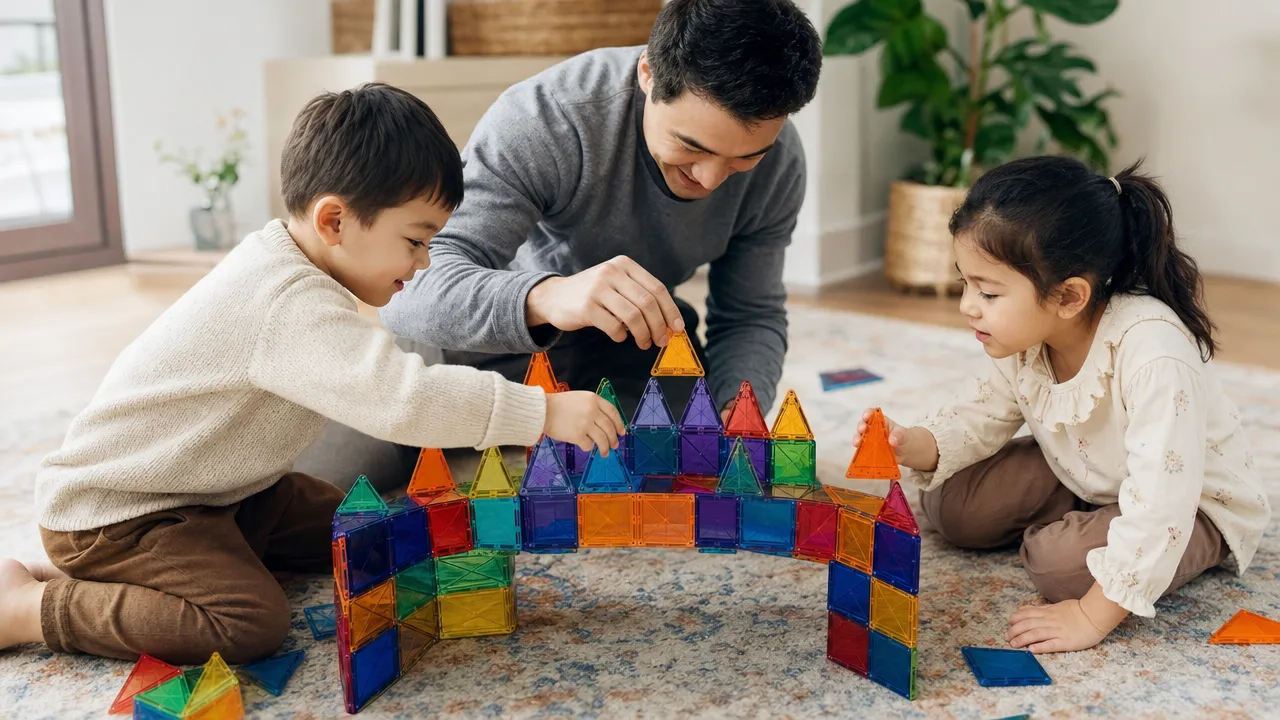
For more parent-focused guidance on checking product details and choosing educational building toys carefully, read how to evaluate educational building toys.
Easy activities in a magnetic tile gift guide for preschoolers
These magnetic tile activity ideas work best when the set is labeled appropriately for the child and used according to its instructions.
| Activity | What to do | Parent prompt |
|---|---|---|
| Shape hunt | Ask your child to find shapes that match your description | "Can you find two triangles?" |
| Color sorting | Group tiles by color before building | "Which color should we build with first?" |
| Flat pattern copying | Make a small 2D pattern for your child to recreate | "Can you make yours look like mine?" |
| Build a home | Create rooms, walls, and a roof for pretend play | "What does your home need?" |
| Tower test | Build a tower and experiment with the base | "What could make it steadier?" |
| Symmetry picture | Make one half of a simple design and complete the other half | "What shape belongs on this side?" |
| Bridge challenge | Connect two small structures with a bridge | "How can we join these sides?" |
| Shape restaurant | Pretend to fill orders using named shapes | "May I have one square and two triangles?" |
| Animal shelter | Build a habitat using separately age-appropriate toy animals | "How will the animal stay dry?" |
| Build and rebuild | Photograph a simple design and recreate it later | "What do you remember about this build?" |
| One-change game | Change one tile in a structure and observe the result | "What changed when we moved this piece?" |
| Cleanup sorting | Find and sort pieces as part of putting the set away | "Can we check that every piece is ready to store?" |
Keep play child-led whenever possible. Your role is to offer a question, help with a frustrating connection, and maintain the safe-use routine.
Magnetic tile gift guide for preschoolers checklist and FAQs
Before buying, use this quick checklist:
- Confirm the exact age grade for the individual set.
- Read warnings and instructions before gifting.
- Choose a scope that fits first play, travel, or shared building.
- Review the actual shape and contents list.
- Check that product information and support details are clear.
- Plan a dedicated storage space.
- Inspect the tiles on arrival and regularly during use.
- Remove cracked or damaged pieces immediately.
- Verify compatibility directly if buying an expansion.
- Avoid assuming that price, piece count, or marketing claims alone determine value.
Are magnetic tiles good preschool building toys?
They can offer preschoolers opportunities to explore shapes, spatial relationships, balance, storytelling, and collaborative building. The value comes from the child's active play and the conversations around it, not from a guaranteed developmental promise.
What should I do if a magnetic tile is cracked?
Remove it from play immediately. The AAP recommends checking magnet-containing toys for cracks where a magnet could come loose. Keep damaged pieces separate from usable toys until you can follow the manufacturer's instructions for disposal or support.
How many pieces should a first magnetic tile set have?
There is no universal number. A first set should feel manageable for the child's play style and your storage space. Compare the included shapes and expected use, not only the piece count.
Can preschoolers use magnetic tiles independently?
That depends on the exact product's age guidance, the child's behavior, the condition of the pieces, and whether younger children can access the play area. Follow the instructions for the specific set and use adult supervision when appropriate.
What if a child may have swallowed a magnet?
Seek immediate medical attention. The CPSC advises urgent action for suspected magnet ingestion.
A useful magnetic tile gift for preschoolers is not necessarily the biggest set. It is a set that matches the child's age label, interests, play environment, and your family's consistent routine for inspection and storage. When you compare current details carefully, magnetic tiles for kids can become a flexible source of creative, hands-on family play.