

Buy STEM toys for kids that are safe and genuine
Are you confused when choosing a STEM toy that promises learning but leaves you unsure whether it is truly safe for your child? Many parents, especially mothers with babies or toddlers at home, feel that exact tension. You want your child to build, sort, imagine, and problem-solve, but you also notice the small pieces, magnets, age labels, and vague product listings that make you pause.
In my opinion, buying STEM toys for kids should never start with the question, "Will this make my child smarter?" It should start with, "Is this toy age-appropriate, genuine, and safe enough for my home?" Learning value matters, but safety comes first. The best choice is usually a toy that encourages open-ended play while giving parents clear information about age grading, warnings, materials, seller identity, and how the toy should be used.
For families interested in hands-on building play, Vmaisi offers YRZtiles Kids Magnetic Tiles Educational Toys, a relevant collection for parents comparing magnetic tile options. As with any magnetic building toy, parents should review the product page, age label, warnings, and supervision needs before play.

What STEM toys for kids should really mean
STEM toys for kids are toys that encourage children to explore science, technology, engineering, and math through play. That can include building tiles, blocks, shape sorters, puzzles, gears, coding games, robotics kits, or simple cause-and-effect toys for younger children.
The most useful STEM play is not always complicated. A child stacking blocks is already experimenting with balance. A preschooler connecting magnetic tiles is exploring shape, symmetry, structure, and stability. A child rebuilding a tower after it falls is practicing iteration, which is one of the simplest forms of engineering thinking.
Authoritative learning sources often describe STEM toys as tools for exploration and problem-solving, not as shortcuts to guaranteed achievement. Research discussed by the University of Delaware connects block play with spatial thinking and early math development. A peer-reviewed article available through PMC also discusses links between block-building activities and spatial assembly skills.
That is why educational building toys for kids can be valuable: they give children something physical to test. But parents should be cautious about exaggerated claims. No toy should be treated as a guarantee of better grades, advanced intelligence, or faster development. A good STEM toy may support curiosity, creativity, spatial language, and problem-solving when it is age-appropriate and used with supervision.
Here is a simple way to think about common STEM toy categories:
| Toy type | Learning value | Parent safety focus |
|---|---|---|
| Large blocks | Balance, stacking, spatial reasoning | Size, smooth edges, non-peeling surfaces |
| Magnetic tiles | Geometry, symmetry, structure building | Securely enclosed magnets, cracks, age label |
| Shape sorters | Matching, sorting, early problem-solving | Large pieces, no detachable small parts |
| Gears and mechanical toys | Cause and effect, motion, sequencing | Pinch points, small gears, batteries |
| Science or electronics kits | Experimenting, observation, logic | Batteries, tools, chemicals, supervision |
Why STEM toys for kids require a safety-first mindset
STEM toys for kids can involve parts that require more attention than a soft plush toy or board book. Building sets may contain small pieces. Magnetic tiles contain magnets. Electronic STEM toys may contain button or coin batteries. Science kits may include tools or materials that need adult supervision.
For children under 3, choking hazards are one of the biggest concerns. The U.S. Consumer Product Safety Commission explains small-parts requirements and choking hazard labeling for toys and children's products. Parents should treat age labels as safety guidance, not just skill recommendations.
Magnets also deserve special attention. The CPSC magnet safety center warns that swallowed magnets can cause serious internal injury, especially if more than one magnet is swallowed. For magnetic building toys, parents should inspect tiles often and discard any cracked or broken pieces immediately.
Button batteries are another serious risk. Some electronic STEM toys use small batteries that can be dangerous if swallowed. The CPSC button battery safety resource explains why battery compartments should be secure and inaccessible to children.
Cleaning matters too, especially when babies or toddlers mouth toys. The CDC guidance on cleaning children's toys is a useful reference for parents who want to keep frequently handled toys hygienic.
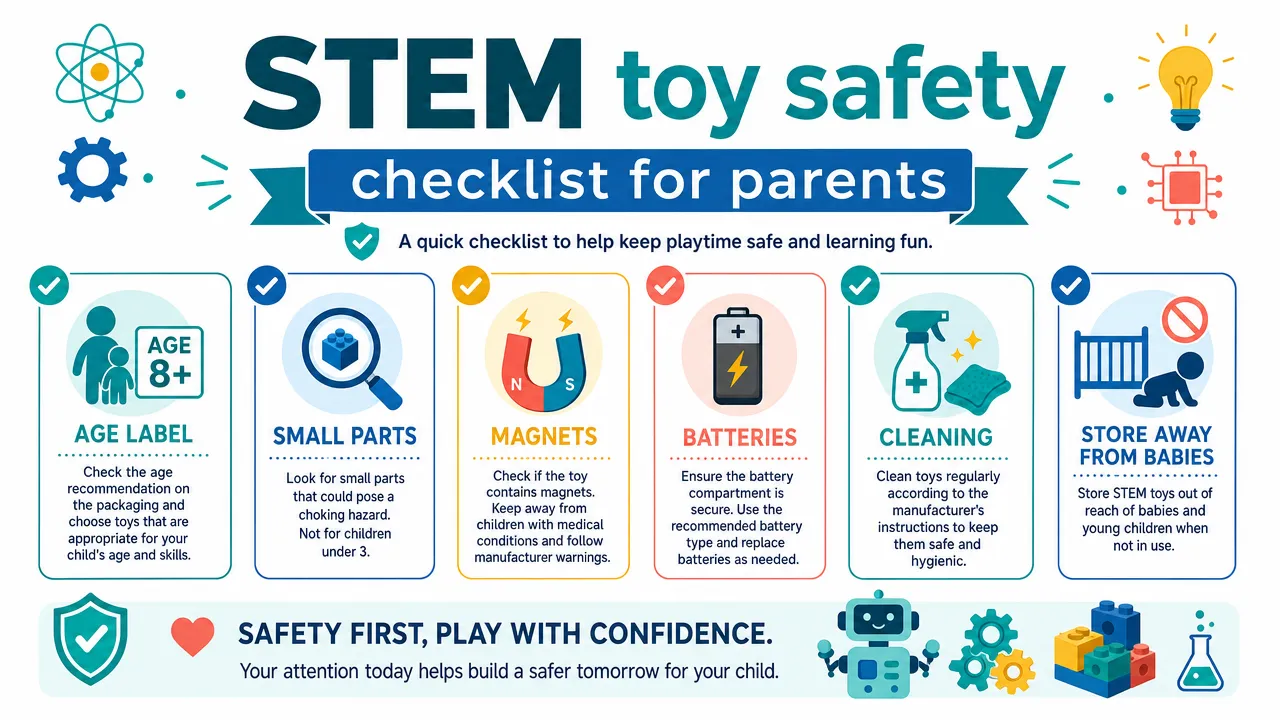
In homes with more than one child, safety can become more complicated. A building set labeled for a 6-year-old may be fine for the older child but unsafe if a crawling baby can reach the pieces. In my view, this is where many parents underestimate risk. The toy itself may not be the wrong choice, but the play environment may be wrong for the youngest child in the home.
A practical safety rhythm can help:
How to choose genuine STEM toys for kids
Choosing genuine STEM toys for kids is about more than avoiding disappointment. Counterfeit or poorly documented toys may lack clear warnings, traceability, safe materials, or reliable quality control. The Toy Association has warned about risks connected with counterfeit and non-compliant toys sold online in its fake toys white paper. Michigan State University's Center for Anti-Counterfeiting and Product Protection also provides consumer guidance about avoiding fake products in its counterfeit toy warning.
When I evaluate a toy listing, I look for boring details first. That may sound strange, but genuine product information is often practical and specific. A trustworthy listing should make it easy to identify what the toy is, who is selling it, what age it is intended for, and what warnings apply.
Be cautious if you see:
- No clear age grading.
- No manufacturer or seller information.
- No safety warnings.
- Very poor spelling or blurry packaging.
- Product photos that do not match the item delivered.
- A suspiciously low price compared with similar toys.
- Strong chemical odor after opening.
- Loose magnets, weak seams, or brittle plastic.
- No return or support information.
Parents comparing magnetic tiles can review YRZtiles Magnetic Tiles Educational STEM Toys for Kids Toddlers Children, which the research report identified as the most relevant product page for this topic. The available research mentions age 3+ and multiple set sizes, but it did not provide verified certification documents. For that reason, parents should read the live product page carefully and check any packaging or documentation included with the product.
That transparency matters. A product can be attractive and educational, but parents still need to verify age suitability, warnings, and condition before allowing play.
What standards parents should check for STEM toys for kids
STEM toys for kids are regulated differently depending on the market where they are sold. In the United States, the CPSC explains that ASTM F963 is a mandatory toy safety standard under federal toy safety rules. The CPSC also provides an ASTM F963 requirements chart for businesses and manufacturers.
For parents, the important point is not to memorize every standard. The important point is to ask better questions:
| What to check | Why it matters |
|---|---|
| Age grade | Indicates safety and developmental suitability |
| Choking warnings | Especially important for children under 3 |
| Magnet information | Helps parents inspect and supervise magnetic toys |
| Battery compartment design | Button and coin batteries must be inaccessible |
| Material information | Helps avoid unknown or questionable materials |
| Seller contact details | Supports returns, questions, and traceability |
| Cleaning instructions | Important for babies, toddlers, and shared play |
| Recall awareness | Helps parents avoid known unsafe products |
In the EU, toy sellers may reference EN71 and CE marking. In Great Britain, UKCA marking may apply. These labels vary by market, and a label alone should not be treated as proof that a toy is risk-free. Documentation and responsible use still matter.
This is also why I prefer careful language around toy safety. It is reasonable to say that a toy may support learning or may be appropriate when used according to its age label. It is not responsible to say any toy is "100% safe." Every toy depends on the child's age, behavior, supervision, condition of the toy, and the home environment.
Age-appropriate STEM toys for kids by stage
The best STEM toys for kids change as children grow. A toy that is perfect for a 5-year-old may be unsafe for a 2-year-old. The NAEYC toy guidance emphasizes choosing toys by age and stage, and the CPSC booklet Which Toy for Which Child is another useful parent reference.
For babies under 12 months, STEM-style play should be simple: soft blocks, textured balls, board books, unbreakable mirrors, activity mats, and large sensory toys. The goal is not engineering. The goal is safe exploration, grasping, looking, mouthing, and early cause-and-effect discovery. Avoid magnets, batteries, small blocks, and anything with detachable hard parts.
For toddlers ages 1 to 3, choose large blocks, nesting cups, shape sorters, large puzzles, and sturdy stacking toys. Choking risk remains high, so avoid small parts and toys labeled 3+ for children under 3. If an older sibling uses magnetic building toys, store them where the toddler cannot reach them.
For preschoolers ages 3 to 5, age-appropriate magnetic tiles, larger interlocking blocks, pattern blocks, simple gears, and beginner construction sets can be engaging. This is often the stage when educational building toys for kids become especially useful because children can begin planning, comparing shapes, and building more intentionally.
For children ages 6 to 8, more complex construction sets, beginner robotics, marble runs, coding games, and simple circuit kits may be suitable, depending on the child. Parents should still watch for batteries, small parts, and younger siblings.
For children ages 9 and older, advanced robotics, coding kits, model-building sets, strategy games, and electronics kits can introduce deeper STEM thinking. Supervision may still be needed for tools, heat, batteries, or chemicals.
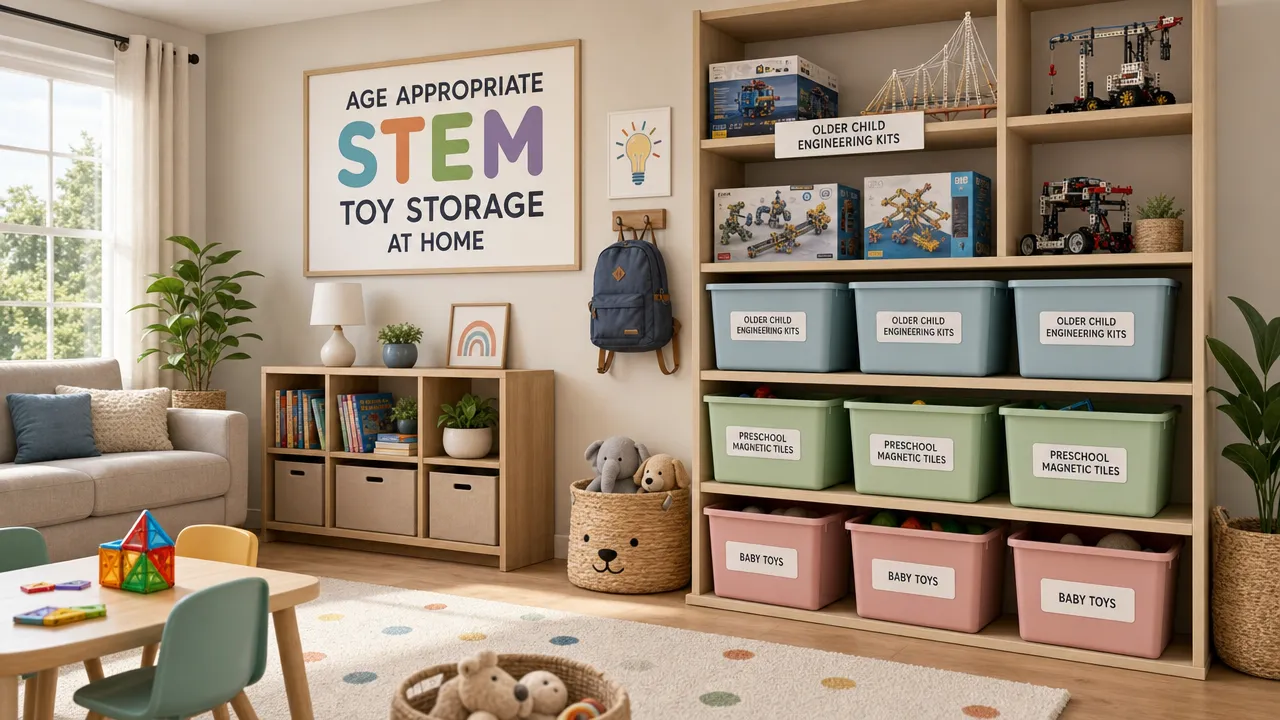
The storage system matters almost as much as the purchase. If you have a baby and an older child, separate bins are not optional. Small STEM pieces should be stored high, latched, or in a room the baby cannot enter. After play, count and inspect pieces before putting them away.
Parents who want a larger building option can compare the YRZtiles Magnetic Tiles for Kids Toy 100 Pieces. Families who prefer to start smaller can review the YRZtiles Magnetic Tiles for Kids Toy 60 Pieces. Both pages are relevant to magnetic tile play, but parents should still confirm age suitability, warnings, and product details before buying.
Buying STEM toys for kids with confidence
My strongest recommendation is simple: buy STEM toys for kids the way you would buy any child safety product. Slow down. Read the label. Inspect the toy. Ask whether the product fits your youngest child, not just your most interested child.
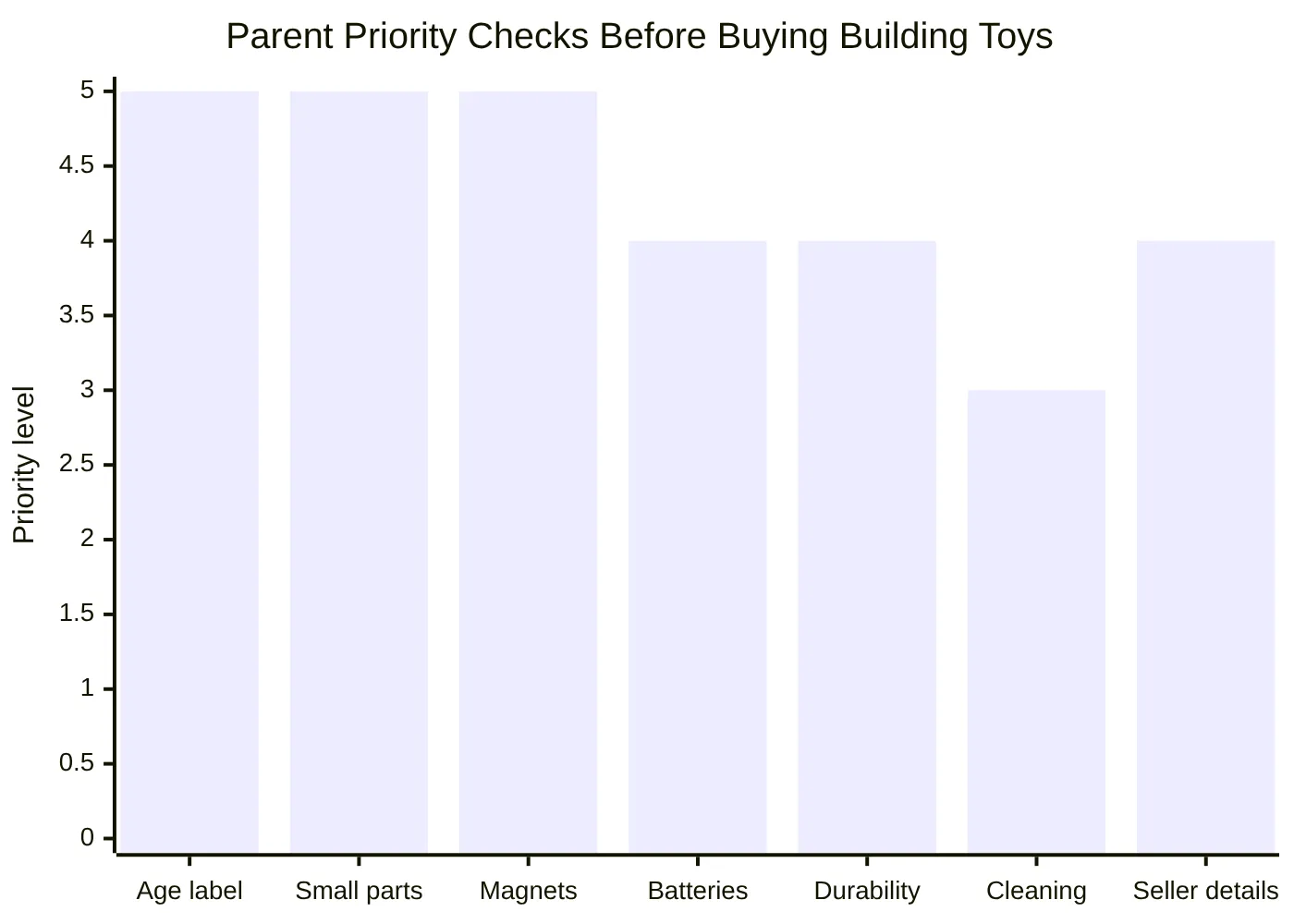
Before adding a toy to your cart, use this checklist:
- Is the age label appropriate for my child?
- Does the toy include small parts?
- If it has magnets, are they fully enclosed?
- If it has batteries, is the battery compartment secure?
- Are materials, warnings, and use instructions clear?
- Is the seller identifiable?
- Does the product page provide enough detail?
- Can I clean the toy appropriately?
- Will younger siblings be able to access it?
- Do I understand when to discard broken pieces?
For parents ready to compare a relevant building toy, the primary product landing page from the research report is YRZtiles Magnetic Tiles Educational STEM Toys for Kids Toddlers Children.
Product image note: the research report did not provide an official product image URL. When publishing this article, use the official image from the product landing page rather than inventing or substituting an unrelated product photo. If an editorial image is needed, use a clearly labeled lifestyle or AI-generated image that does not imply unverified certification claims.
The bottom line is that educational building toys for kids can be a smart choice when they are selected carefully. Magnetic tiles, blocks, puzzles, and construction sets can help children practice spatial reasoning, creativity, and early engineering habits. But learning value should never outrank safety. Choose genuine products, check age labels, inspect pieces often, supervise play, and store toys in a way that protects babies and toddlers in the home.