

How to Choose Child Safety Locks for Your Fridge
Child safety locks for fridge doors should be chosen by matching the lock type to your refrigerator layout, surface material, child's behavior, and daily adult access needs. A fridge lock is a childproofing aid that helps reduce toddler access to food, glass containers, medication stored cold, spills, and repeated door opening. It does not replace supervision.

The most practical choice for many homes is a no-drill adhesive strap when the fridge has a smooth exterior surface and the lock can be placed away from the gasket, hinge, dispenser, display, and door swing. For a multi-use no-drill option designed for fridges, cabinets, drawers, dishwashers, toilet seats, cupboards, ovens, and trash cans, see the 6 Pack Vmaisi Multi-Use Adhesive Straps Locks.
How child safety locks for fridge doors reduce common toddler access risks
Use child safety locks for fridge doors when a child can pull the handle, open the door repeatedly, remove items, or leave the refrigerator open.
Common fridge access risks include:
- Glass jars or bottles falling from shelves.
- Choking hazards such as grapes, hard foods, small food pieces, or packaging parts.
- Spilled liquids that create slipping hazards.
- Medication access when medicine is stored in the refrigerator.
- Spoiled food risk when the door is left open.
- Pinched fingers from repeated opening and closing.
- Climbing or pulling on shelves after the door opens.
Medication should be stored securely and out of reach. Poison Control provides separate guidance on medicine safety, including the need to keep medicines away from children.
Start using a lock when the child begins crawling, pulling up, walking, or imitating adult appliance use. Continue use until the child consistently follows rules and no longer tests doors, latches, and handles.
Do not treat any lock as a complete barrier. The CPSC describes safety latches and locks as part of home childproofing, not as a substitute for adult supervision. See the CPSC guidance on childproofing your home.
Which child safety locks for fridge styles fit different refrigerators
Match the lock to the refrigerator before buying. Door style, surface shape, handle layout, and adult access frequency determine the best fit.
| Fridge type | Better lock approach | Placement rule | Avoid |
|---|---|---|---|
| Single-door fridge | Adhesive strap from door to side panel | Place on firm exterior surfaces | Gasket, hinge, and curved trim |
| Top-freezer refrigerator | Separate locks for fridge and freezer if both are accessible | Test each door independently | Assuming one lock covers both doors |
| French-door fridge | One or two flexible straps depending on door movement | Check both door swings before applying adhesive | Blocking center seals or handles |
| Side-by-side fridge | Strap or dedicated appliance lock | Keep away from dispenser and display areas | Blocking water or ice access panels |
| Handleless refrigerator | Adhesive strap or flat-surface latch | Use smooth front or side surfaces | Handle clamps |
| Stainless steel fridge | No-drill adhesive with careful surface prep | Clean with non-abrasive methods | Scrapers, harsh removal tools, or drilling |
Adhesive strap locks are flexible and often suitable for smooth refrigerators. They are also useful for families who prefer one style across several household locations.
Rigid latch locks can work on flat, consistent surfaces. They may be less adaptable on curved or irregular refrigerator edges.
Keyed or combination locks provide more adult-controlled access. They are less convenient for a door opened many times per day.
Handle-based clamps depend on handle shape. They may not fit handleless fridges or may allow partial opening on some designs.
Multi-purpose appliance straps can reduce product mismatch across rooms. Vmaisi groups these options in the Multi-use Child Safety Locks collection.
For additional fridge and oven placement examples, Vmaisi has a related fridge and oven safety guide that addresses refrigerator layouts, adhesive placement, and appliance access risks.
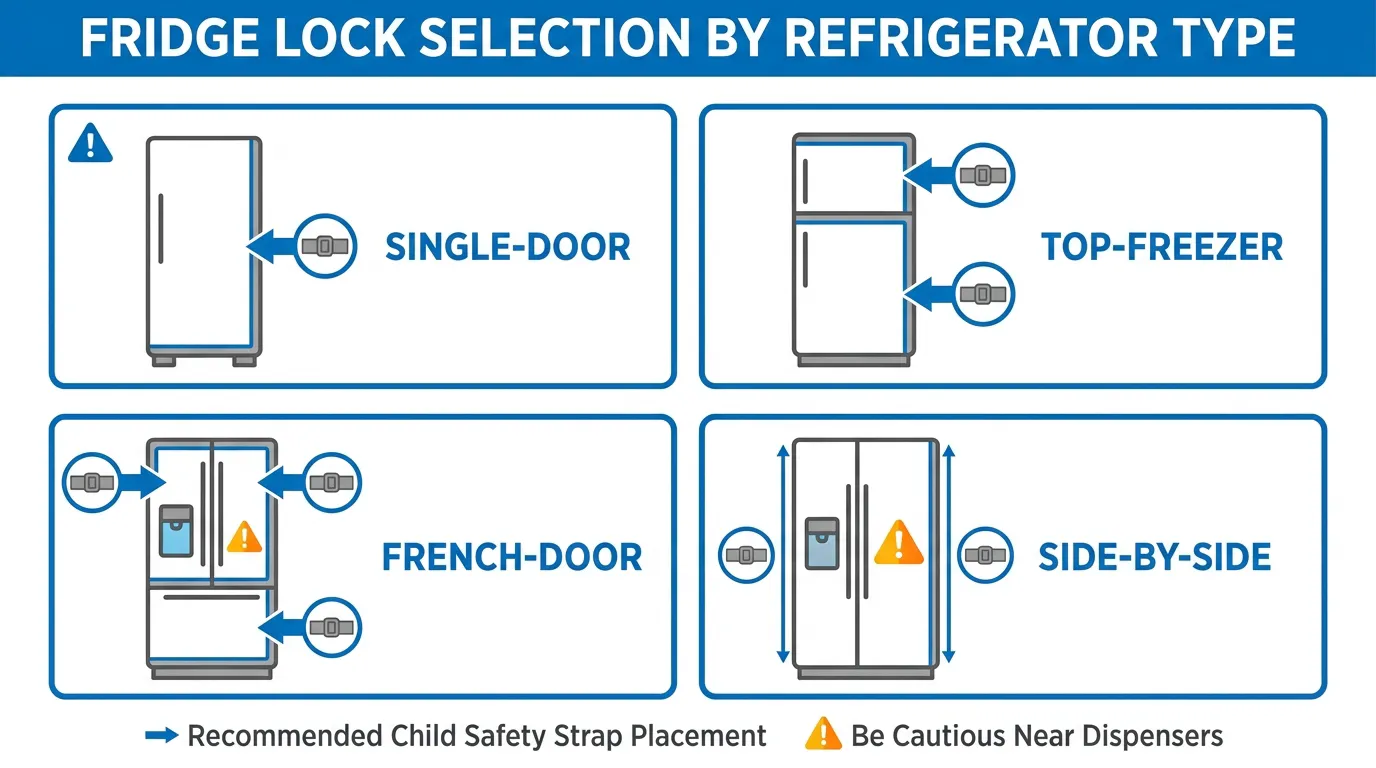
Choose the simplest lock that adults will use every time. A difficult lock is often left undone. For high-use appliances such as refrigerators, adult convenience is a safety factor because consistency controls whether the lock works in daily routines.
How to install child safety locks for fridge doors correctly
Install child safety locks for fridge doors only on clean, dry, stable surfaces. Adhesive failure is often caused by grease, moisture, rushed installation, poor alignment, or use before curing.
Follow this installation sequence:
- Close the refrigerator door fully.
- Select a mounting area that does not touch the gasket, hinge, dispenser, display, vent, or moving trim.
- Hold the lock in place without removing the adhesive liner.
- Open and close the door to confirm the strap does not block movement.
- Clean the selected surfaces.
- Remove fingerprints, grease, dust, moisture, and cleaner residue.
- Dry the surface fully.
- Mark the placement lightly if needed.
- Remove the adhesive liner.
- Press each adhesive anchor firmly for 30 to 60 seconds.
- Allow the adhesive to cure according to the product instructions.
- Test gently before daily use.
- Inspect monthly for peeling, cracks, looseness, or broken parts.
Do not mount the lock on the refrigerator gasket. A blocked gasket can affect the door seal and appliance function.
Do not install on damp, greasy, textured, or unstable surfaces. Adhesive needs direct contact with a smooth, dry surface.
Do not let a child pull on the lock during curing. Early force can weaken the bond.
Do not keep using a damaged lock. Replace locks with cracked plastic, stretched straps, loose adhesive pads, or broken release parts.
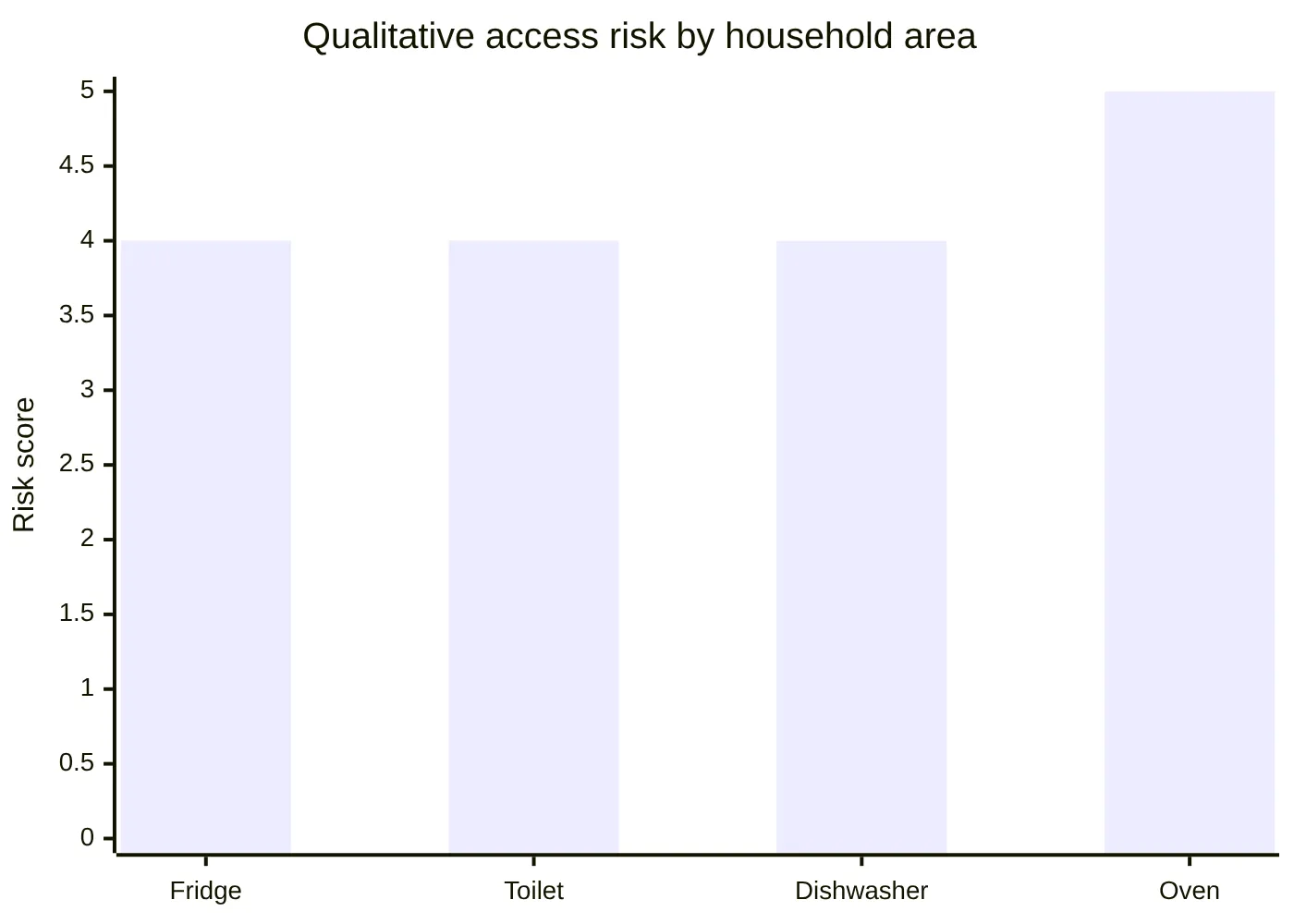
The chart is a qualitative planning aid, not injury data. It shows why parents often childproof the refrigerator at the same stage as bathroom and kitchen appliances. Access frequency, hazard type, and child behavior should guide priority.

For kitchens with nearby lower cabinets, use cabinet-specific locks where needed. The Vmaisi Magnetic Child Safety Cabinet Locks, 16 Pack is a separate option for cabinets and drawers around food storage, cleaning products, or appliance accessories.
How child safety locks for fridge compare with toilet seat, dishwasher, and oven use
Child safety locks for fridge doors address food access and repeated door opening. Other household locks address different hazards. Do not assume the same placement rules apply to every surface.
| Area | Main risk | Lock approach | Installation caution |
|---|---|---|---|
| Fridge | Food, glass, spills, medication, door opening | Adhesive strap, latch, keyed lock, or multi-use appliance strap | Avoid gasket, hinge, dispenser, and display |
| Toilet seat | Water access, hygiene, germs, clogs | Dedicated toilet lid lock or suitable strap placement | Moisture and cleaning products can weaken adhesive |
| Dishwasher | Detergent, knives, glassware, steam, hot dishes | Physical door restraint plus detergent storage | Built-in control lock may not stop the door opening |
| Oven | Burns, hot door, hot racks, controls | Oven door restraint plus knob or control protection where needed | Avoid hot vents and high-heat surfaces |
Child safety locks for toilet seat use should be checked more often in bathrooms. Moisture, cleaners, and frequent wiping can reduce adhesive performance. HealthyChildren, from the American Academy of Pediatrics, provides guidance on drowning prevention, including close supervision around water.
Child safety locks for dishwasher use should be combined with safe storage of detergent. Keep detergent packets high, locked, and out of reach. Poison Control explains risks related to laundry and detergent packets.
Child safety locks for oven use need heat-aware placement. Do not mount adhesive near hot vents, hot glass, or areas exposed to high temperatures. Oven door locks do not control knobs. For more appliance-specific details, use the Vmaisi oven lock selection guide.
For dishwashers, physical restraint matters because some electronic control locks stop button use but do not always stop the door from opening. Vmaisi provides a separate dishwasher safety lock guide for detergent, door, and loading risks.
For families childproofing several appliances at once, the Vmaisi kitchen and appliance bundle guide can help plan quantities and locations without mixing incompatible lock types.
Child safety locks for fridge buying checklist and next step
Use this checklist before selecting a fridge lock:
- Confirm the refrigerator type.
- Confirm the door swing.
- Confirm the surface is smooth, clean, and dry.
- Confirm the lock will not touch the gasket.
- Confirm the lock will not block the hinge.
- Confirm the lock will not cover a dispenser, display, or vent.
- Confirm adults can open and relock it with normal daily use.
- Confirm the child cannot easily imitate the release.
- Confirm installation does not require drilling if you are renting or avoiding appliance holes.
- Confirm the product can be inspected and replaced if worn.
Choose a no-drill adhesive strap when the refrigerator has a suitable surface and you want a removable, multi-use childproofing aid. Choose a keyed or combination lock only when stronger adult-controlled access is needed and frequent unlocking will not cause caregivers to stop using it.
Use a dedicated product for locations where moisture, heat, or door geometry makes a general strap unsuitable. Toilet seats, dishwashers, and ovens create different installation conditions from refrigerators.
Inspect installed locks monthly. Replace worn locks immediately. Keep broken parts away from children because small pieces can become choking hazards. The CPSC provides additional child safety information in its child safety toolkit.
For a no-drill option designed for fridge, dishwasher, toilet seat, cupboard, oven, trash can, cabinet, and drawer use, go to the 6 Pack Vmaisi Multi-Use Adhesive Straps Locks. For more pack sizes and related strap options, browse the Vmaisi Multi-use Child Safety Locks collection.