

Why Spring Cabinet Latches Suit Homes That Do Not Want Keys
Spring cabinet latches appeal to many households for one simple reason: there is no separate key to find. The latch sits inside a compatible cabinet or drawer, and an adult releases it by opening the door slightly and pressing the internal mechanism.
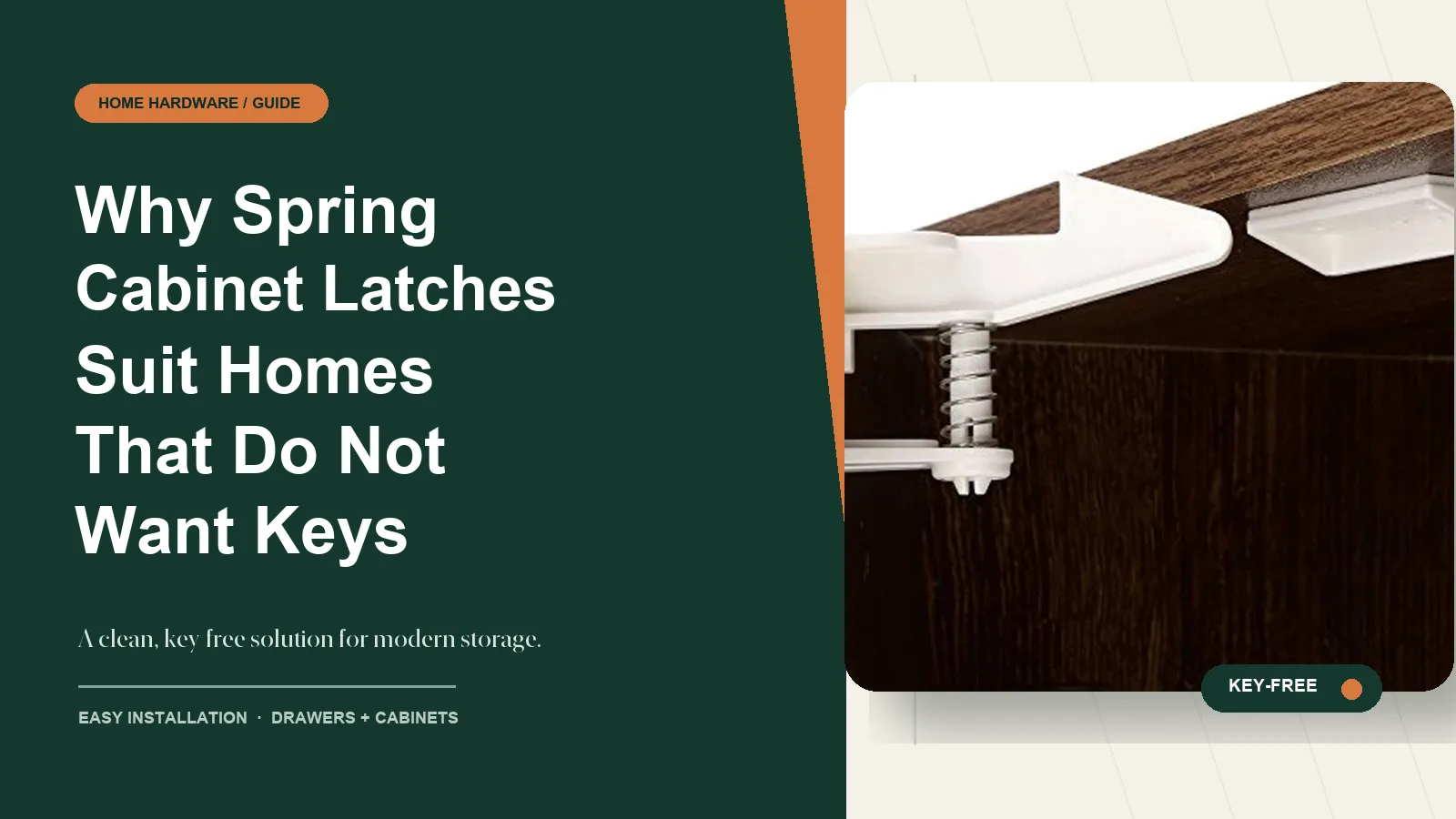
That routine can be convenient, but the product still needs the right cabinet geometry and careful installation. A manual latch is useful only when it catches consistently, leaves enough room for an adult to reach the release, and stays securely attached to the interior surface.
How an internal spring latch works
A spring latch and its catch are mounted inside the cabinet or drawer. When the door closes, the latch engages and prevents the door from opening fully. An adult pulls the door open a small distance, reaches through the gap, presses the latch down, and opens the door the rest of the way.
The latch is mostly hidden while the cabinet is closed. Unlike a magnetic cabinet lock, it does not need an external magnetic key. It also does not relock an open cabinet on its own. The adult must close the door fully so the latch can engage again.
This design works best when:
- The latch and catch have flat interior mounting areas.
- The door or drawer follows a predictable closing path.
- An adult can reach the release through the limited opening.
- Hinges, shelves, pipes, drawer slides, and stored items stay clear.
- The cabinet closes fully without forcing the latch.
If the door can be pulled open so far that a child can reach the release or the contents, the position needs to be reconsidered.

Why a no-key routine can be easier
Magnetic locks require adults to keep track of a separate key and place it over the correct point on the cabinet front. A spring latch replaces that step with direct access to the internal release.
This can be helpful on cabinets that adults open often. There is no key to carry between rooms, no storage spot to remember, and no need to mark the magnetic release position on the door. Caregivers also do not need to share the location of a hidden key.
The tradeoff is the partial opening. Adults need enough finger room to press the latch, and the opening should not expose hazardous contents. People with limited hand strength or mobility may find the press-and-open action uncomfortable. Test the motion before installing a full set.
| Daily-use question | Spring latch | Magnetic cabinet lock |
|---|---|---|
| How does an adult open it? | Open slightly and press the internal release | Place a magnetic key over the lock position |
| Is a separate accessory needed? | No | Yes |
| What must be easy to reach? | The internal latch | The stored magnetic key |
| Main fit concern | Interior alignment, clearance, and finger access | Interior alignment, door material, and magnetic access |
| What restores protection? | Closing the door until the latch engages | Closing the door so the internal lock engages |
Neither type is right for every home. The better option is the one adults can operate correctly every time and that fits the actual cabinet.
Which cabinets are good candidates
Look inside the cabinet before deciding. The visible door style does not tell you whether the latch will fit. Face frames, inset doors, drawer boxes, shelves, plumbing, and hardware can change the available mounting space.
A promising location has two stable surfaces that allow the latch and catch to meet squarely. The latch needs room to move, and the release must remain accessible after the door stops at the intended gap.
Check these points during a dry-fit:
- Hold the latch and catch in their proposed positions.
- Close the door or drawer slowly.
- Watch where the two pieces meet.
- Confirm that the latch engages every time.
- Open the door to the stopped position and test adult finger access.
- Check for contact with hinges, slides, shelves, pipes, bumpers, or stored items.
- Repeat the closing motion several times.
Do not proceed if engagement is intermittent or the door needs extra force. More adhesive will not correct a poor angle, warped door, narrow mounting rail, or obstructed release point.
Drawers often require the most careful check. A drawer may look spacious from the front while its slides, upper rail, or deep box occupy the exact area where the latch would move.
Prepare the surface and align the parts
Adhesive needs a clean, dry, stable surface. Kitchen grease, bathroom moisture, furniture polish, soap film, dust, and loose paint can weaken contact. Clean the mounting areas by the method given in the product instructions and let them dry completely.
Avoid surfaces that are rough, peeling, powdery, sharply curved, or too narrow for the full adhesive pad. If only an edge of the pad touches, find another position or use a different safety plan.
Once the dry-fit is reliable:
- Mark the position if the instructions recommend it.
- Remove the backing only when both parts are ready to place.
- Press each part firmly and evenly as directed.
- Leave the cabinet undisturbed for the stated bonding period.
- Keep hazardous contents somewhere else until curing and testing are complete.
Do not borrow a cure time from another adhesive product. Follow the directions for the exact latch you install.

The VMAISI 12-pack product page also lists screws as an optional reinforcement method. If you choose that method, first confirm that permanent holes are acceptable, the cabinet material can hold the screws, and the screw length will not penetrate the visible side. Adhesive or screws cannot make an incompatible location suitable.
Test the latch before relying on it
After the stated bonding period, close and open the cabinet repeatedly. The latch should catch each time without scraping, shifting, or making the door difficult to close. An adult should be able to reach the release without pinching a finger or contacting the stored items.
Test from more than one pulling angle, but do not use excessive force that could damage the cabinet. Watch the adhesive edges and the latch position during the test. If either part moves, stop and reassess the installation.
Then check the adult routine:
- Can each caregiver operate the release comfortably?
- Does everyone remember to close the door until it catches?
- Can a child reach through the gap?
- Does the opening expose any dangerous item?
- Does the latch still work after the cabinet is restocked?
Move medicines, cleaning chemicals, sharp tools, batteries, and other high-risk items to safer storage whenever possible. A cabinet latch should not be the only protection around especially hazardous contents.
Consider the limitations before choosing this style
The no-key design removes one inconvenience, but it introduces others. A child can sometimes see the latch through the opening and may learn by watching adults. The small gap can also create a finger-pinch concern. Adults must avoid yanking the door against the latch.
Spring latches may be a poor fit when:
- The release cannot be reached comfortably.
- The gap is large enough for a child to reach inside.
- Pipes or drawer slides block the mechanism.
- The mounting surface is damp, greasy, damaged, or uneven.
- The door is warped or badly misaligned.
- The cabinet needs immediate emergency access.
Children's abilities change quickly. A setup that worked several months ago may no longer limit access once a child is taller, stronger, or familiar with the release. Regular reassessment matters as much as the initial installation.
Choose a pack only after checking fit
Count individual doors and drawers that both need restricted access and pass the dry-fit. A smaller project may use a 12-pack, while broader multi-room coverage may require more. Do not count an unsuitable location simply to justify a larger package.
For a focused cabinet-and-drawer project, the VMAISI Child Safety Latches 12 Pack is an internal manual option that does not require a magnetic key. Review the current package details and installation instructions before buying.
Install one latch and test it before completing the full project. Cabinets within the same room can differ in surface finish, frame depth, hinge position, and clearance.
Keep checking the installation
Inspect active latches regularly, especially on frequently used cabinets and in damp or greasy areas. Look for lifted adhesive, cracks, loosened catches, shifted alignment, door sag, or a latch that no longer engages consistently. Recheck after adjusting a hinge, reorganizing the cabinet, or cleaning around the hardware.
Stop relying on a latch that moves, peels, breaks, or works only some of the time. Relocate hazardous contents while you repair or replace the setup. A no-key spring latch can make daily cabinet access simpler for adults, but it remains effective only when the cabinet fits the product and the latch is closed, tested, and maintained.