

Where Should You Install Magnetic Cabinet Locks First? A Room-by-Room Guide
Are you standing in the hallway wondering whether to secure the bathroom vanity, the kitchen sink cabinet, or that low drawer your toddler suddenly loves to open? If so, my opinion is simple: do not start with the room you use most. Start with the reachable storage that contains the highest-risk items.
For many families, that means bathroom cabinet locks belong near the top of the list, right next to the kitchen under-sink cabinet, sharp-tool drawers, and laundry storage. The goal is not to make your home feel locked down or stressful. It is to add a practical safety layer where it matters most, while still moving hazardous items higher, keeping them out of sight, and supervising closely.
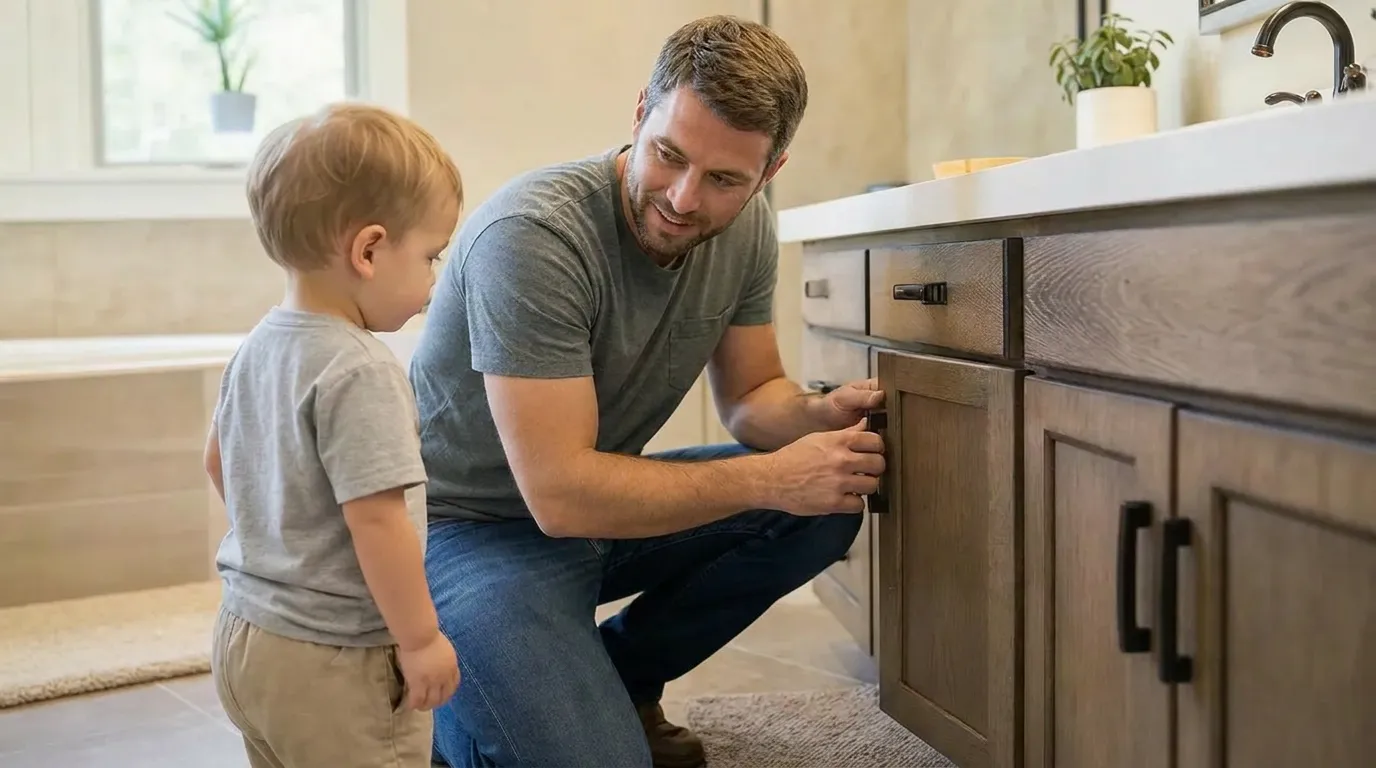
Bathroom cabinet locks should start with risk, not room order
When parents ask where to install child safety cabinet locks first, I think the best answer is: rank every cabinet and drawer by three questions.
- What is inside?
- Can your child reach it?
- How often is it opened?
A rarely used laundry cabinet with detergent may deserve attention before a daily-use linen drawer with towels. A bathroom vanity with medicines, razors, cosmetics, or cleaners may be more urgent than a living room cabinet full of blankets.
The U.S. Consumer Product Safety Commission recommends using safety latches and locks on cabinets and drawers in kitchens, bathrooms, and other areas to help reduce access to medicines, laundry detergent, household cleaners, knives, and sharp objects. That is a helpful framework: focus first on reachable storage with contents that could cause poisoning, injury, choking, cuts, or suffocation.
Here is a simple way to think about priority:
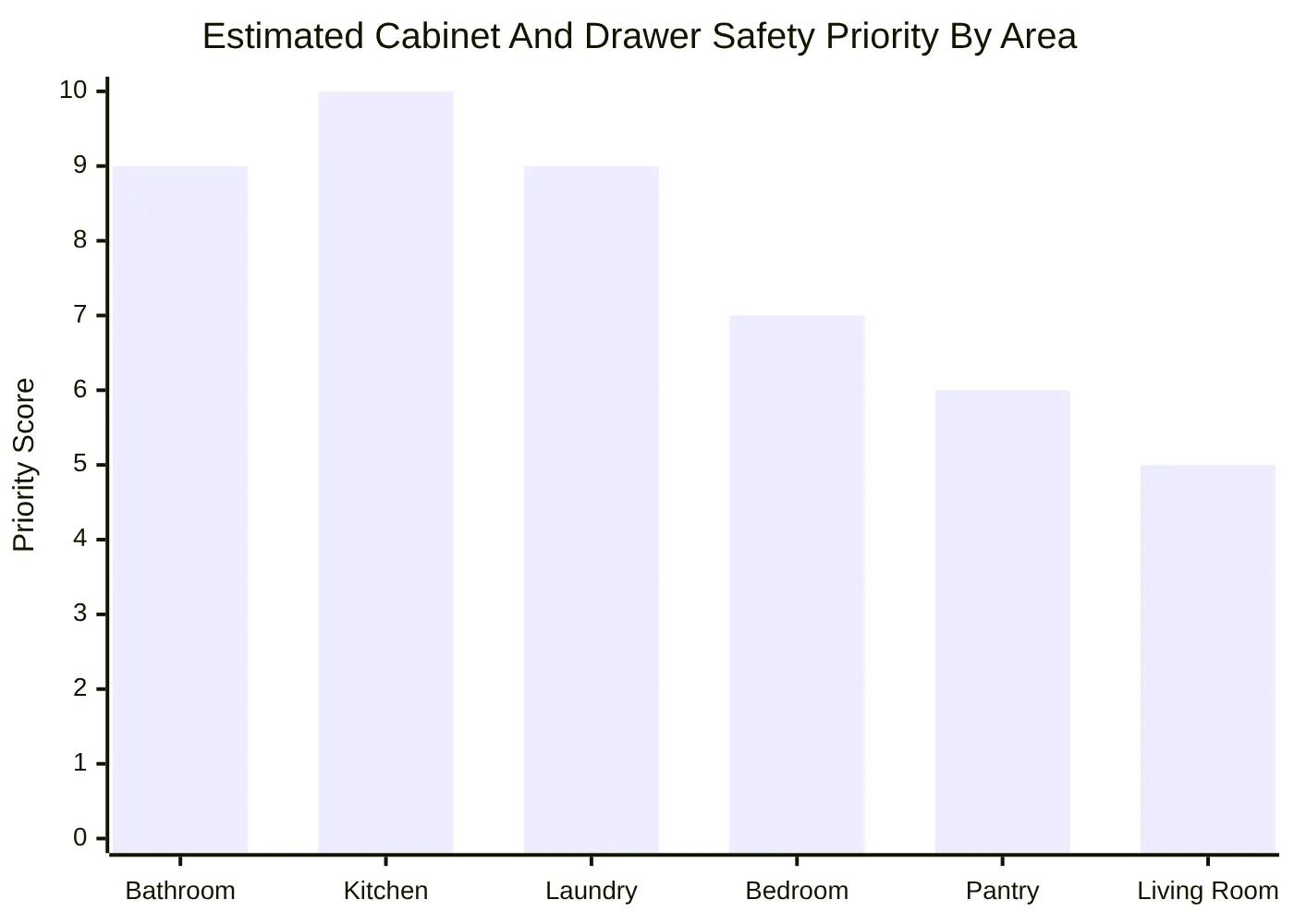
This chart is not an injury dataset. It is a planning guide based on common household storage patterns. Your home may differ, especially if you keep medicines in a bedroom, cleaners in a garage cabinet, or sharp tools in a utility drawer.
Bathroom cabinet locks in bathrooms: what to secure first
Bathroom cabinet locks are a high priority because bathroom storage is often at toddler height. Vanities and lower drawers can hold items that seem ordinary to adults but are not appropriate for babies or toddlers to access.
Start with these bathroom zones:
| Bathroom area | Why it matters | What to do first |
|---|---|---|
| Vanity cabinet | Often stores cleaners, toiletries, razors, and extra supplies | Add cabinet latches and move high-risk items up |
| Lower drawers | May contain grooming tools, cosmetics, small caps, or medicine packets | Use drawer safety locks where contents are not child-safe |
| Reachable medicine storage | Child-resistant caps are not fully childproof | Move medicines out of reach and sight |
| Under-sink area | May contain bathroom cleaners or toilet products | Secure it early or relocate contents |
The American Academy of Pediatrics via HealthyChildren.org reminds parents that medicines should be stored out of reach and sight, and that child-resistant packaging is not fully childproof. The CDC medication safety guidance also recommends putting medicines, vitamins, and supplements away every time.
My practical take: if your baby has started crawling, pulling up, or opening cabinet fronts, the bathroom vanity should not wait until the end of your baby-proofing project. Install child safety cabinet locks there early, but do not rely on them alone. Move medicines, supplements, razors, and cleaners higher whenever possible.
Also remember that bathroom safety is broader than cabinet storage. Water, toilets, tubs, slippery floors, and small objects all require adult attention. Cabinet latches help reduce access to stored items, but they do not replace supervision.
Bathroom cabinet locks and how to babyproof kitchen cabinets next
After the bathroom, most parents should quickly move to the kitchen. If you want to babyproof kitchen cabinets in a practical order, start under the sink, then move to lower drawers and cabinets with sharp, breakable, heavy, or small items.
The kitchen often has several high-priority zones:
| Kitchen zone | Common concerns | Priority |
|---|---|---|
| Under-sink cabinet | Cleaners, dishwasher detergent, trash bags, sponges | Very high |
| Sharp-tool drawers | Knives, peelers, graters, scissors, skewers | Very high |
| Lower cabinets | Glass, ceramic dishes, heavy cookware, breakables | High |
| Pantry lower storage | Glass jars, plastic bags, small food items, heavy cans | Medium to high |
| Trash or recycling storage | Plastic bags, packaging, small discarded items | High if reachable |
The CPSC also warns that laundry packets and pods can be a serious poisoning hazard and should be locked up and out of sight. In homes where dish or laundry products are stored under the kitchen sink, that area moves to the top of the list.
Plastic bags are another overlooked issue. The CPSC notes that plastic bags can pose a suffocation risk, so lower pantry cabinets, trash storage, and under-sink areas deserve a close look.
My opinion: parents sometimes spend too much time debating whether to secure every single kitchen cabinet immediately. A better first pass is to secure the few cabinets and drawers that would create the biggest problem if opened: under-sink storage, sharp-tool drawers, and lower cabinets with breakables or heavy cookware.
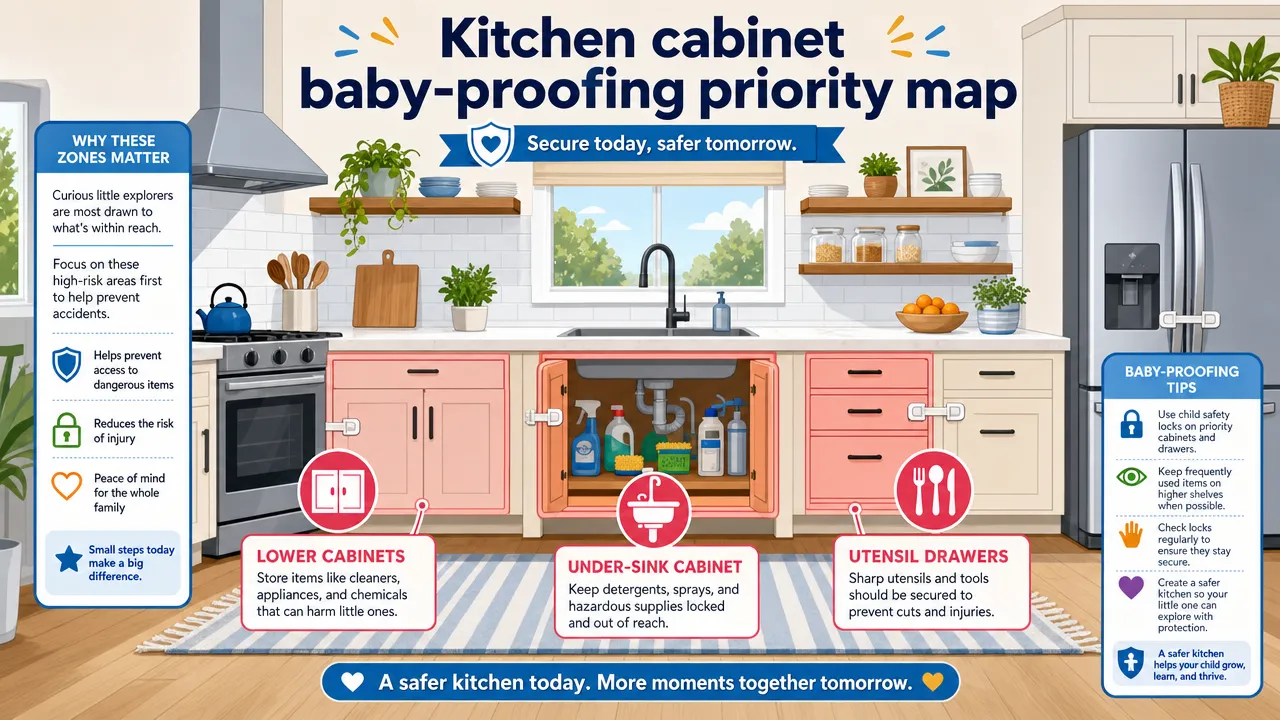
Bathroom cabinet locks and drawer safety locks: room-by-room checklist
Drawer safety locks matter because hazards are not limited to cabinet doors. A low drawer can contain batteries, coins, nail clippers, scissors, cords, jewelry, medicine packets, craft items, or small objects. In some homes, the most important thing to secure is not a cabinet at all.
Use this room-by-room checklist as a first-pass plan:
| Room or area | Secure first | Common contents to review | Estimated coverage |
|---|---|---|---|
| Bathroom | Vanity cabinets and lower drawers | Medicines, razors, toiletries, cleaners, small caps | 2 to 6 latches per bathroom |
| Kitchen | Under-sink cabinet and sharp-tool drawers | Cleaners, knives, peelers, glass, plastic bags | 6 to 12+ latches |
| Laundry room | Detergent storage and lower utility drawers | Detergent, pods, bleach, stain removers, tools | 2 to 6 latches |
| Bedroom | Nightstands and low dresser drawers | Medicines, supplements, coins, batteries, jewelry | 2 to 6 latches |
| Pantry | Lower cabinets and pull-out drawers | Glass jars, heavy cans, bags, small food items | 2 to 6 latches |
| Living room | Media cabinets and storage drawers | Batteries, remotes, cords, candles, small items | 2 to 8 latches |
| Utility storage | Low cabinets with tools or chemicals | Hardware, batteries, craft supplies, cleaners | 2 to 8 latches |
Bedroom storage is especially easy to underestimate. UF Health notes that children can find medicines in places like bedside drawers, handbags, and pockets. That supports a whole-home mindset: bathroom cabinet locks are important, but medicine safety does not stop at the bathroom.
Batteries also deserve attention. The National Capital Poison Center warns that button batteries can cause severe internal injury if swallowed. If a drawer contains batteries, remotes with loose battery compartments, small electronics, or loose coins, treat it as a higher-priority drawer.
A good rule: if your child already explores a storage area, move it up the list. Baby-proofing should respond to real behavior, not just a generic room order.
Bathroom cabinet locks installation and pack-size planning
Adhesive cabinet locks and no-drill cabinet locks are popular with parents because they are practical. They can help secure cabinets and drawers without drilling into cabinet surfaces, which is especially helpful for renters or anyone who wants a simpler installation process.
For rental homes, VMAISI has additional guidance on adhesive, no-drill child safety latches for renters, including the importance of suitable surfaces and careful installation.
For most parents, installation planning should look like this:
- Walk through the home from your child's eye level.
- Count reachable cabinets and drawers that contain high-risk items.
- Clean and dry the mounting surfaces before applying adhesive cabinet locks.
- Check alignment before pressing the latch into place.
- Follow the product instructions for bonding time.
- Test each cabinet or drawer after installation.
- Recheck regularly for lifting, loosening, or misalignment.
Bathroom and kitchen surfaces can have moisture, dust, grease, or cleaning residue, so surface preparation matters. Adhesive works best on clean, smooth, dry, intact surfaces. I would also check bathroom latches more often because humidity and frequent cleaning can affect many adhesive products over time.

Now, how many do you need?
If you are securing only the bathroom vanity, one under-sink cabinet, and a few lower drawers, the VMAISI Cabinet Locks Child Safety Latches 12 Pack is a practical starter choice. It fits smaller homes, apartments, grandparents' homes, or a focused first safety pass.
If you are doing a larger room-by-room pass across the kitchen, bathroom, laundry room, pantry, and bedroom storage, the VMAISI Cabinet Locks Child Safety Latches 20 Pack is the better fit. It is designed for broader coverage and is especially useful if you have multiple bathrooms, a large kitchen, or want extra cabinet latches on hand as your child grows.
| Home scenario | Better fit | Why |
|---|---|---|
| Small apartment | VMAISI 12 Pack | Focused coverage for the highest-risk cabinets and drawers |
| One bathroom plus basic kitchen coverage | VMAISI 12 Pack | Good first-pass option |
| Large kitchen and laundry room | VMAISI 20 Pack | More coverage for multiple zones |
| Multiple bathrooms | VMAISI 20 Pack | More latches for repeated vanity and drawer coverage |
| Whole-home baby proofing | VMAISI 20 Pack | Better for multi-room planning |
Cabinet latches are one safety layer. They help reduce access, but they do not make hazardous storage child-safe by themselves. Move medicines, cleaners, detergent products, sharp tools, batteries, plastic bags, and breakables higher and out of sight whenever you can.
Bathroom cabinet locks FAQs for practical parents
Which cabinets should I secure first?
Start with reachable cabinets and drawers that contain medicines, cleaners, sharp tools, laundry products, batteries, small objects, plastic bags, or breakables. In many homes, the first priorities are bathroom vanities, kitchen under-sink cabinets, sharp-tool drawers, laundry storage, and nightstands.
Are bathroom cabinet locks more important than kitchen latches?
I would not frame it as one room always beating the other. Instead, compare what is inside. A bathroom vanity with medicines and razors is very high priority. A kitchen under-sink cabinet with cleaners is also very high priority. If both are reachable, secure both early.
Should I use drawer safety locks too?
Yes. Drawer safety locks are especially important for lower kitchen drawers, bathroom vanity drawers, nightstands, craft drawers, and media storage. Children often discover drawers before parents expect it.
What should I move higher even after installing cabinet latches?
Move medicines, vitamins, supplements, cleaners, laundry detergent, sharp tools, batteries, plastic bags, choking hazards, and breakables higher whenever possible. The CDC recommends putting medicines and supplements away every time, and keeping Poison Help information available.
Are no-drill cabinet locks suitable for renters?
Often, yes. No-drill cabinet locks can be a practical renter-friendly option because they avoid screws and drilling. Still, follow installation and removal instructions carefully, and use them on clean, smooth, dry, intact surfaces.
How often should I check adhesive cabinet locks?
Check them during routine cleaning or at least monthly. Inspect for lifting adhesive, loosened parts, misalignment, cracking, or reduced hold. Recheck more often in humid bathrooms and high-use kitchens.
My final take: do not wait until every room is perfectly organized. Start with the cabinets and drawers your child can reach today. Bathroom cabinet locks, kitchen under-sink coverage, laundry storage, and key drawer safety locks can give parents a calmer, more practical first layer of baby proofing. For focused coverage, choose the VMAISI Cabinet Locks Child Safety Latches 12 Pack. For broader multi-room coverage, choose the VMAISI Cabinet Locks Child Safety Latches 20 Pack.