

How to Childproof an Under-Sink Cabinet When Pipes Block Lock Placement
Pipes, valves, a garbage disposal, shelves, and pull-out bins can leave very little room for an internal cabinet latch. Do not solve that problem by attaching a lock to plumbing or forcing hardware into a narrow gap. First move hazardous products, map the cabinet, and identify surfaces that stay dry and do not interfere with normal door movement or emergency access.
Move hazardous products before measuring
Remove cleaners, dishwasher pods, drain products, medication, sharp tools, batteries, and small loose items before working inside the cabinet. Keep chemical products in their original labeled containers. Never transfer them to cups, food containers, drink bottles, or unlabeled jars.
Move these items to a high locked cabinet or locked utility area if the under-sink space cannot be secured reliably. Relocation is the better choice when:
- The cabinet has an active leak, recurring condensation, or water damage.
- Pipes, a disposal, hoses, shelves, or dividers block every stable lock position.
- A shutoff valve would become difficult for an adult to reach.
- Cabinet panels are swollen, warped, peeling, heavily textured, or too narrow for an adhesive base.
- Adults cannot release and fully reconnect the device during normal use.
- The cabinet remains open for long periods during cleaning or dishwashing.
A lock adds a barrier, but it should not be the only protection for toxic, sharp, or easily swallowed items. Safer storage and adult supervision still matter.
Map the pipes and moving parts
Use a flashlight, tape measure, removable painter's tape, and a simple sketch or photo. Do not disconnect, loosen, bend, or shift plumbing to make room for a lock.
Identify every fixed and moving component:
| Cabinet component | What to check | Placement rule |
|---|---|---|
| Drain tailpiece and P-trap | Position and service access | Keep all lock parts clear |
| Water supply lines | Rigid and flexible sections | Never use as anchor points |
| Shutoff valves | Hand access and turning space | Keep fully reachable |
| Garbage disposal | Housing, cord, vibration, and service space | Avoid contact and attachment |
| Dishwasher or filter hoses | Full route and movement | Never attach an anchor or strap |
| Pull-out shelf or bin | Extension and return path | Test through the full range |
| Cabinet frame | Flat, dry, stable areas | Possible latch or anchor surface |
| Doors and hinges | Swing, gap, and closing path | Keep hardware out of the path |
Follow the door through its complete motion. Open each side separately, then move both doors as they are used in daily life. Watch for contact near hinges, handles, shelves, pipes, and the opposite door.
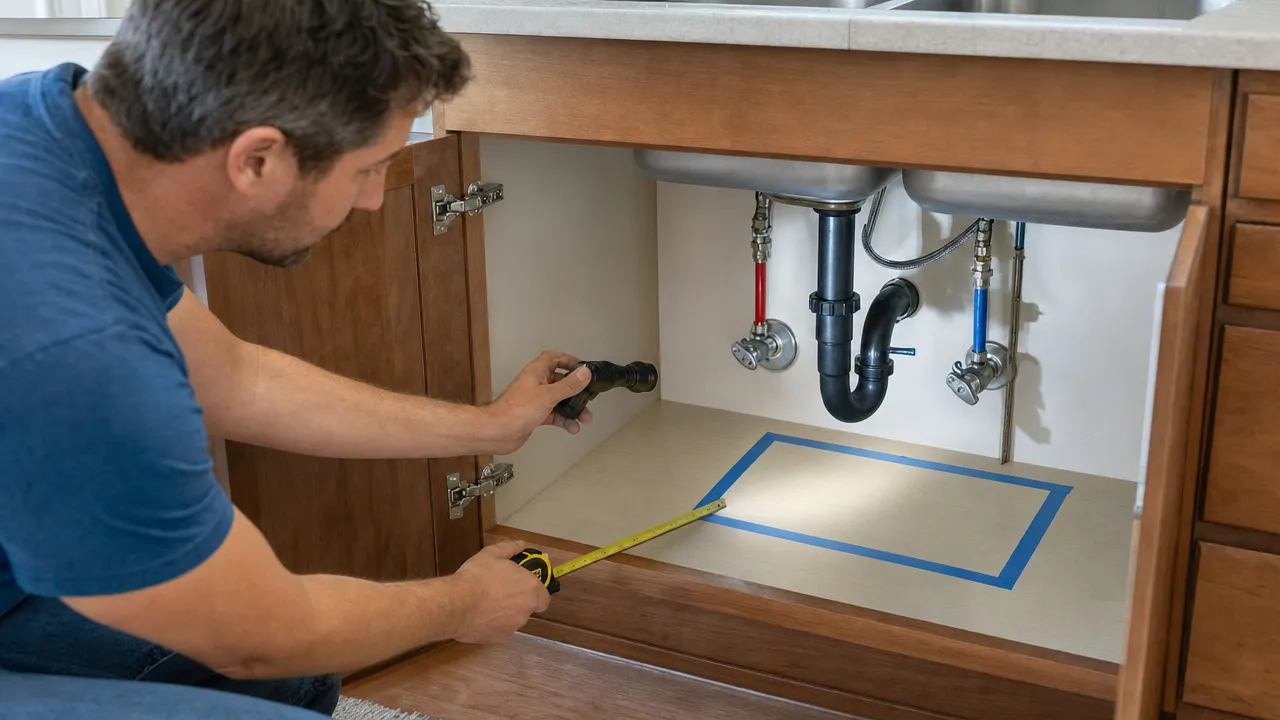
Measure these areas before choosing hardware:
- Interior depth: Distance from the inside face of the closed door to the nearest pipe, shelf, or obstruction.
- Flat mounting area: Uninterrupted width and height available on the frame or door.
- Door-to-frame gap: Clearance around the door edge and between double doors.
- Door swing: Space the latch, anchor, or strap must avoid while the door moves.
- Valve access: Room an adult needs to reach and turn each shutoff valve.
- Moisture exposure: Leaks, condensation, wet wood, splash zones, and stained material near the proposed position.
Reject any location where hardware could rub against plumbing, block the door, or slow access to a water shutoff.
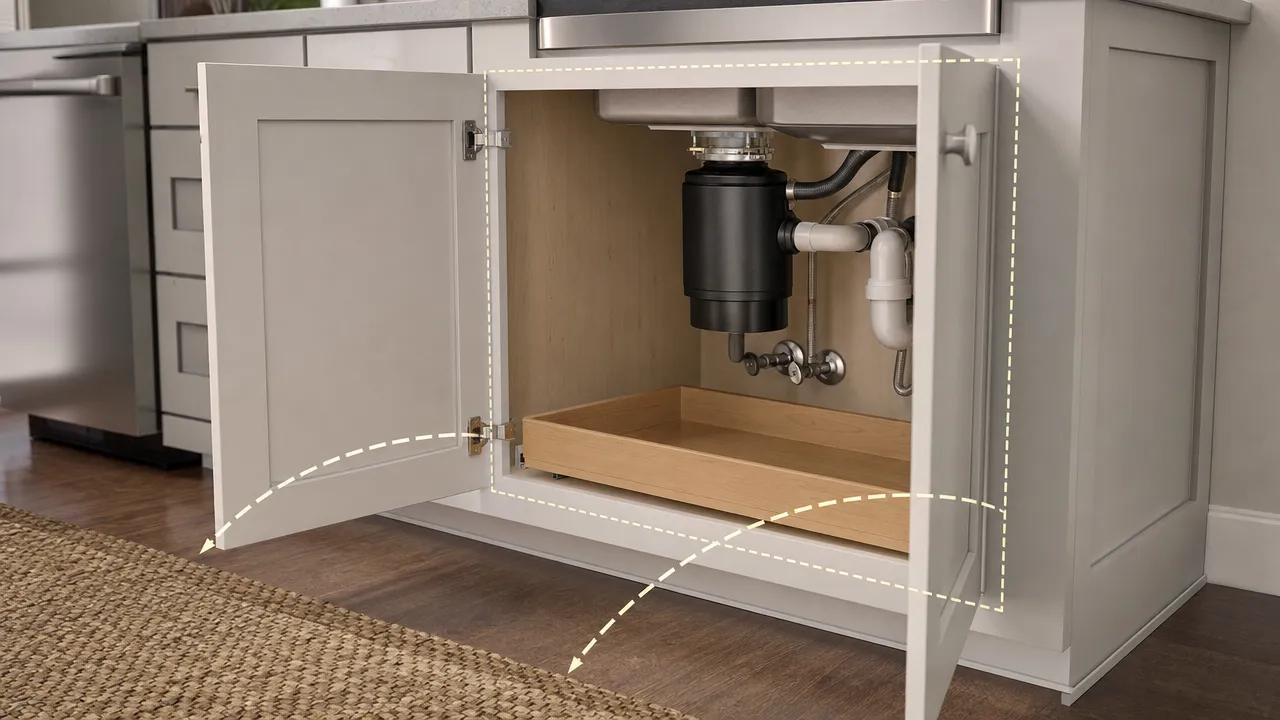
Decide whether an internal latch can fit
An internal adhesive latch needs aligned mounting areas for the latch and catch. The door must close without the latch touching plumbing, a shelf, a hinge, or stored items. The release also needs enough room for an adult's finger.
Use an internal latch only when all of these conditions are met:
- Both parts sit on flat, stable cabinet material.
- The latch and catch align when the door closes.
- The mechanism has room to move and release.
- No part touches pipes, drain lines, hoses, the disposal, shelves, hinges, or cords.
- Installation leaves every shutoff valve and service point accessible.
- The mounting areas are clean, dry, and compatible with the product instructions.
Do not confuse an internal manual latch with an external strap lock. The internal latch sits inside the cabinet and catches when the door closes. The exterior strap uses two adhesive bases joined across the opening and must be reconnected after use.
If the cabinet has enough internal clearance, a manual latch may keep the exterior clean. If plumbing or a pull-out organizer blocks alignment, do not mount the latch crooked or let it press against a pipe. Evaluate an exterior option instead.
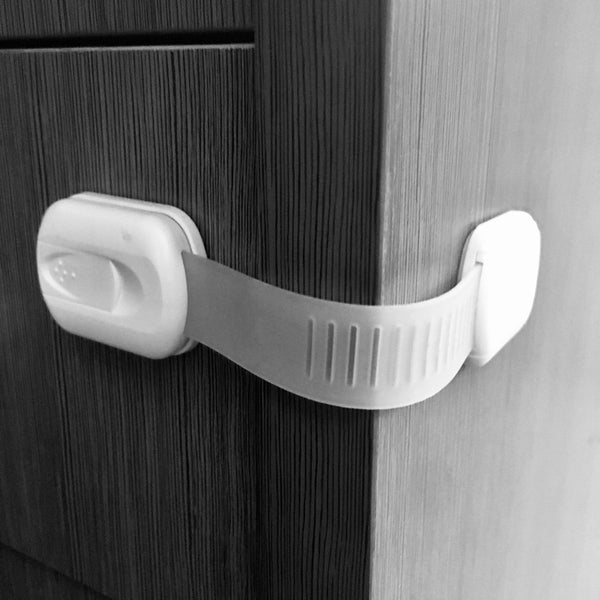
6 Pack Vmaisi Multi-Use Adhesive Straps Locks
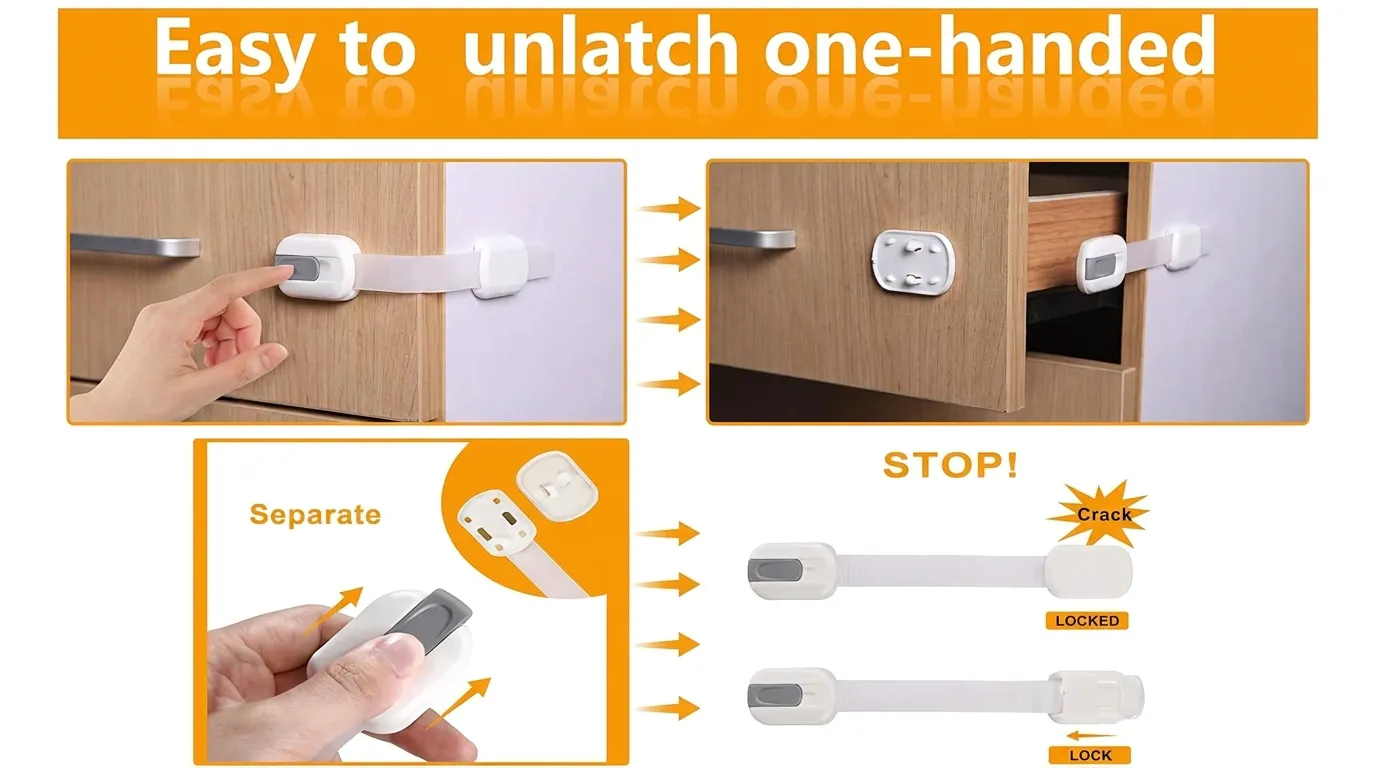
When an external strap is worth evaluating
An external flexible strap can bypass crowded plumbing because both bases stay outside the cabinet. It still needs two compatible attachment areas. On a double-door cabinet, the bases may sit on the two door fronts. On another layout, one may sit on a door and the other on a stable face frame, if the product instructions allow that arrangement.
Check the complete strap route before applying adhesive:
- Both bases must fit entirely on flat, stable surfaces.
- Neither base should bridge a raised panel, groove, seam, or curved edge.
- The strap should cross the opening directly without twisting.
- Handles and neighboring drawers must remain usable.
- Both doors must move normally after the lock is released.
- The release must be convenient enough for adults to reconnect every time.
Moisture still matters even though the hardware is outside. Repeated splashes, damp cleaning cloths, grease, peeling paint, loose laminate, and damaged veneer can make an exterior position unsuitable. A visible strap also receives direct pulling, so inspect it for lifting edges and wear.
Prepare the selected surfaces
Do not apply adhesive until the cabinet passes the fit check. Adhesive cannot correct poor alignment, damp material, an obstructed door path, or an unstable finish.
Use this sequence for an internal latch or exterior strap:
- Read the product instructions for compatible surfaces, cleaning, pressure, curing, and removal.
- Dry-fit every component with both doors closed.
- Open and close each door slowly while holding the parts in place.
- Confirm that nothing touches plumbing, valves, hoses, cords, disposal parts, shelves, hinges, or handles.
- Clean only the selected cabinet surfaces with an approved method.
- Remove grease, dust, moisture, and cleaner residue.
- Let the surfaces dry completely.
- Apply the components squarely and with correct alignment.
- Use the pressure and full curing period stated in the instructions.
- Test the adult release, reconnection, and door movement with gentle force.
Do not mount adhesive hardware on wet wood, swollen particleboard, peeling paint, damaged veneer, loose laminate, deep texture, unfinished material, narrow unsupported strips, or curved edges. Never attach it to a pipe, hose, valve, cord, disposal housing, or moving mechanism.
The adult release should work without yanking the doors or reaching behind pipes. If routine access feels awkward, household members may leave the device open. Find a better position or move the contents instead.
Keep shutoff and service access clear
An under-sink lock must not delay an adult who needs to stop a leak. Close and engage the lock, then confirm that an adult can release it promptly and reach both shutoff valves. A plumber should also be able to access the trap, disposal, filter, hoses, and connections after the device is released.
Do not run a strap around cabinet handles if that route traps a removable panel or blocks a nearby drawer. Do not reinforce a failed installation with tape, cord, wire, or an attachment to plumbing.
If the cabinet has no safe mounting position, leave hazardous products elsewhere. A high locked cabinet or locked utility area is more dependable than a poorly fitted device next to water and plumbing.
Inspect after leaks, repairs, and heavy cleaning
Check the installation regularly and after any event that could change the cabinet or hardware:
- A leak, condensation, or wet cleanup.
- Plumbing, disposal, filter, or dishwasher service.
- Cabinet refacing, hinge adjustment, or shelf changes.
- Repeated pulling by a child.
- New staining, swelling, peeling, or odor inside the cabinet.
Stop relying on the lock if adhesive edges lift, a base loosens, plastic cracks, the strap stretches, the latch stops aligning, or a door no longer closes fully. Reassess the placement if a new hose, bin, or pipe changes the available space.
For an under-sink cabinet with two compatible exterior attachment areas, Vmaisi Multi-Use Adhesive Strap Locks are one external option to evaluate. They are not an internal latch and do not fit every cabinet finish or layout. Dry-fit first, follow the curing instructions, reconnect the lock after every opening, and move hazardous products if the cabinet cannot be secured reliably.
Final measurement checklist
- Hazardous products were removed before work began.
- The drain, P-trap, supply lines, hoses, disposal, cords, and shutoff valves were identified.
- Shelves, bins, dividers, organizers, hinges, handles, and both door paths were checked.
- Interior depth was measured at the proposed latch position.
- Exterior flat space was measured for the full strap-base footprint.
- The mounting material is flat, dry, stable, and compatible.
- No component attaches to or touches plumbing, valves, hoses, cords, disposal parts, or moving hardware.
- Shutoff valves remain easy for adults to reach.
- The device was dry-fitted before adhesive was exposed.
- Product cleaning, pressure, curing, and removal instructions were reviewed.
- The adult release works and the device reconnects completely.
- The cabinet doors close and move normally.
- An inspection is planned after leaks, repairs, cleaning, or heavy pulling.
- Hazardous items have another locked storage location if the cabinet cannot be secured safely.